

Top Sand Blasting Room Manufacturer – Engineered for Efficiency and Durability
2026-05-31
In the world of surface preparation, efficiency and durability aren't just buzzwords—they define the difference between costly downtime and long-term productivity. If you're seeking a top sand blasting room manufacturer that truly engineers solutions for real-world demands, look no further. At PuHua, we blend precision engineering with robust construction to deliver blasting rooms that stand the test of time. But what makes our approach stand out in a crowded market? Let's explore the key features that set our systems apart.
Precision-Engineered Blast Rooms for Unmatched Performance
Every blast room we build starts with a deep understanding of your operational demands. Our engineering team analyzes everything from abrasive type and workpiece dimensions to dust collection requirements and production cycles. This meticulous approach ensures that the room’s geometry, airflow patterns, and structural reinforcements work in harmony. The result is a system that maintains visibility, reduces abrasive breakdown, and keeps particle dispersion exactly where it belongs—inside the controlled environment, not in surrounding areas.
Attention to detail extends to the components that often get overlooked. Reclaim floors are designed with a tapered pitch that moves spent media efficiently without clogging, while the abrasive separator removes fines with minimal loss of reusable grit. Lighting fixtures are positioned to eliminate shadows on complex workpieces, and sound-dampening panels cut noise without creating dust traps. These are not off-the-shelf solutions; each element is selected and calibrated to deliver consistent results hour after hour, shift after shift.
The real measure of performance is longevity under harsh conditions. Walls are lined with heavy-duty rubber or manganese steel in high-impingement zones, and the ventilation system is balanced to handle the surge of dust during peak blasting without losing negative pressure. We even reinforce door seals and hopper transitions because small failures can cascade into downtime. It’s this holistic approach—where every component is chosen for durability and integrated function—that turns a room into a precision tool rather than just a containment shell.
Built to Last: Heavy-Duty Construction and Materials
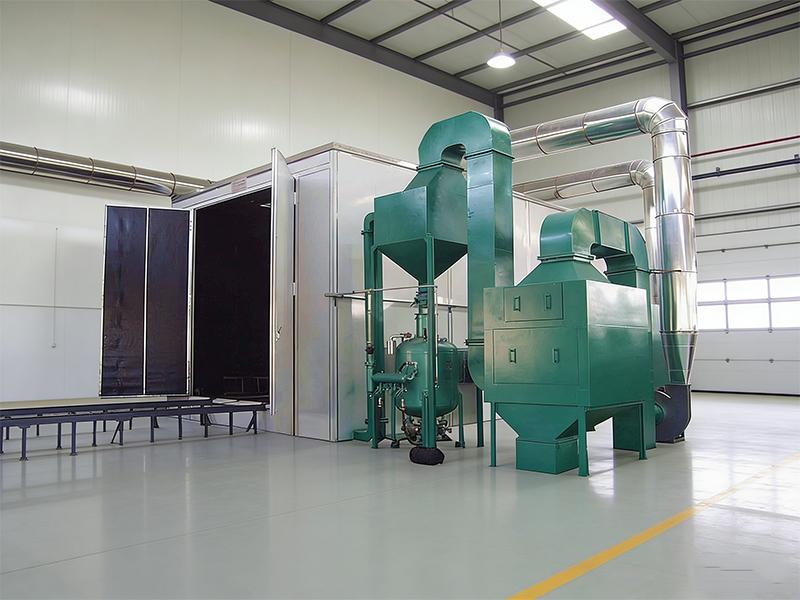
The real backbone here isn’t some abstract promise—it’s the materials themselves. We’re talking thick-gauge steel that resists torsion like a bridge beam, reinforced aluminum alloys that shrug off corrosion, and composite polymers that don’t crack when temperatures swing. These aren’t off-the-shelf parts; each material gets selected for how it behaves under sustained stress, not just how it looks on a spec sheet. The result is a build that feels solid from the first touch, with a weight and rigidity that telegraph reliability before you even put it to work.
Construction matters as much as what it’s made of. Joints are welded—not bolted—where it counts, seams are sealed against moisture and debris, and stress points get extra gusseting that most designs skip. Every piece goes through cycles of load testing that exceed real-world demands, so weak links are caught before they reach you. It’s the kind of overbuilding that doesn’t scream for attention; it just means you spend time using the thing, not nursing it along.
Tailored Solutions That Fit Your Exact Production Needs
Every production line has its own rhythm and challenges, so we start every project by listening—really listening—to what your team faces day to day. Instead of pushing a standard model, we map out your entire workflow, note where inefficiencies creep in, and design a system that slots right into your existing setup. Whether it’s custom fixturing, unique software thresholds, or a footprint that squeezes into a tight corner, the goal is a solution that feels native to your floor.
What you gain is more than just machinery; you get a partner that works at your pace. Operators pick up the controls intuitively because the interface mirrors their familiar tasks. Changeover times drop because the system was built around your most frequent product runs. And as your business shifts—new materials, higher volumes, new regulations—the equipment can be adapted without a forklift upgrade, safeguarding your investment for years ahead.
Streamlined Workflow for Maximum Productivity
Streamlining a workflow isn't about rigid rules—it's about removing friction. Start by mapping out your daily tasks and questioning each step. Does it truly need to be done? Often, we hold onto routines out of habit, not necessity. Cutting away low-impact activities frees up mental space for the work that moves the needle.
A streamlined setup also leans on simplicity. Instead of juggling multiple apps or complex systems, focus on a handful of core practices. Batch similar tasks, set clear boundaries for deep work, and leave room to adapt. The goal isn't to cram more into your day but to make the hours feel less chaotic. Small, intentional adjustments often yield the most lasting changes in how smoothly things run.
Advanced Dust Collection and Abrasive Recovery Systems
Modern high-performance dust collection and abrasive recovery systems redefine cleanliness and material reuse in demanding industrial environments. Unlike conventional setups that simply move contaminants from one area to another, these advanced units integrate cyclonic pre-separation, self-cleaning nano-fiber filtration, and automated pulse-jet mechanisms to maintain consistent airflow even under heavy loads. The result isn’t just cleaner air—it’s a measurable reduction in filter wear and a notable drop in energy consumption, as the system adjusts fan speed dynamically based on real-time particulate readings.
What sets these systems apart is their ability to recover and grade spent abrasive media with striking precision. Instead of discarding mixed particles as waste, they use multi-stage vibratory classifiers and air-wash separation to strip away fines and contaminants, returning clean, dimensionally consistent abrasive back to the blast pot. This closes the loop in an effective way: operators see less fresh media purchases, minimal disposal costs, and a more uniform surface profile because the recycled abrasive performs almost identically to virgin material. Magnetic separators and destoners can be integrated seamlessly, removing ferrous fragments and tramp materials that would otherwise compromise coating adhesion.
The smart controls layer adds another dimension, turning a once-dumb utility into an active asset. Embedded sensors track differential pressure, hopper fill levels, and airflow velocity, feeding data to a centralized controller that not only alerts staff to maintenance needs but can also signal downstream process adjustments. This level of connectivity means the dust collector becomes part of the plant’s digital nervous system—far from a standalone box, it’s a node that optimizes blasting operations, extends equipment life, and helps meet ever-tightening emissions standards without constant manual oversight.
Rigorous Testing and Quality Control from Start to Finish
Before a single component takes shape, our engineers set baseline requirements that exceed typical industry thresholds. Raw materials are screened for consistency—down to particulate size, tensile strength, and thermal stability—long before they enter the production queue. Digital fragility models and iterative prototyping expose weak points that wouldn’t surface in standard stress tests, so we correct them at the blueprint stage. This early investment in prevention means fewer surprises downstream and a smoother path from concept to completion.
Once manufacturing begins, in-line audits happen at intervals most would consider excessive. Laser measurement rigs capture dimensional drift to the micron, while accelerated aging chambers simulate years of wear in a matter of days. If a batch shows even marginal variation, the entire run gets quarantined and re-evaluated, not just sample-checked. Operators record environmental conditions alongside output data, building a forensic trail that links every finished piece to the exact moment it was made.
Final approval is more than a visual once-over. Assembled units undergo load cycling, leak-down tests, and random destructive sampling to confirm they perform beyond rated limits. We replicate real-world abuse scenarios—temperature swings, vibration profiles, corrosive mists—until we’re satisfied the product won’t just survive but thrive in the field. Only then does it earn the sign-off label, backed by inspection logs that stay with the customer for the life of the asset.
FAQ
Efficiency in a sand blasting room comes from a combination of factors: optimized airflow systems that quickly clear dust, well-designed abrasive recovery floors that recycle media automatically, and precise control over blast pressure and media flow. The layout should also minimize operator fatigue, allowing for longer, more productive work cycles without sacrificing quality.
Durability starts with robust construction using heavy-duty steel and protective linings that resist abrasive wear. Proper ventilation keeps dust from settling and corroding components, while regular maintenance of wear parts like gloves, nozzles, and recovery systems extends operational life. Quality manufacturing with corrosion-resistant coatings and reinforced joints also plays a key role.
Absolutely. A well-designed room should be flexible enough to accommodate a range of sizes and shapes. Adjustable conveyors, turntables, or overhead cranes can be integrated, and the blasting system should allow operators to switch between different media types and pressures quickly. Many manufacturers offer modular designs that can be tailored to specific industries, from automotive parts to large steel structures.
Safety is non-negotiable. Look for sealed doors with safety interlocks, proper dust collection to prevent respiratory hazards, and emergency stop buttons within easy reach. Noise-reducing insulation and vibration dampening also protect operators. Additionally, a good room will have clear visibility through abrasion-resistant windows and adequate lighting, so the operator always has full control.
A high-efficiency dust collector is critical. It not only maintains a clear view inside the room but also prevents abrasive dust from escaping into the workspace, protecting both workers and nearby equipment. Efficient dust removal reduces contaminants that could otherwise recirculate and affect blast quality, and it reduces the frequency of filter changes, cutting down on downtime.
Beyond the basic specs, look at engineering expertise and after-sales support. Examine the materials used, the warranty terms, and whether they offer turnkey installation. Ask about customization capabilities—can they adapt the room to your specific workflow? Real-world customer feedback and case studies often reveal how well the systems hold up under continuous use. It's also wise to choose a manufacturer that provides operator training and spare parts availability.
Conclusion
Every detail in these blast rooms reflects an obsession with real-world performance. From the first design sketch, engineering precision takes center stage—airflow, lighting, and abrasive flow are mapped to eliminate dead zones and ensure consistent, repeatable results. Heavy-gauge steel frames and reinforced panels aren't an afterthought; they form the backbone of a system meant to endure years of punishing use without warping or leakage. Because no two production lines are identical, each installation begins with a thorough analysis of part dimensions, throughput targets, and material types, resulting in a configuration that feels less like a standard product and more like a natural extension of the shop floor.
Efficiency doesn't stop at the blast nozzle. The workflow inside the room is choreographed to minimize handling, with ergonomic access, intelligent media delivery, and rapid cycle times that keep projects moving. Behind the walls, high-capacity dust collectors and multi-stage abrasive reclaimers work continuously to maintain visibility and separate reusable grit from fines, cutting waste and media costs dramatically. Before a room ever ships, it undergoes full-load trials and component-level inspections that go far beyond a basic checklist. This commitment to exhaustive testing, combined with robust construction and adaptive design, produces a workhorse that delivers clean profiles, lower operating expenses, and the kind of dependability that production managers count on day after day.
Contact Us
Contact Person: Bruce
Email: [email protected]
Tel/WhatsApp: +86 15166629468
Website: https://www.povalchina.com/