
Top Artificial Flowers That Look Just Like the Real Thing
2026-10-21
Have you ever leaned in for a sniff, only to realize the bloom in front of you is silk? That’s the new bar for faux florals—and it keeps rising. In this guide, we’re rounding up the top artificial flowers that could fool even a seasoned gardener, from velvet-petaled roses to lifelike trailing ivy. Whether you’re chasing zero-maintenance decor or just tired of wilting stems, these picks prove realism isn’t reserved for fresh cuts. And if you’re ready to skip the trial and error, PHLEEYA has already curated a collection that nails every detail down to the dewdrops.
Silk Petals That Could Pass for Garden Cuts
The first thing you notice is the light. These silk petals catch it the way a fresh garden rose does at dawn—soft at the edges, deeper where the layers fold. Run a thumb over the surface and there's a faint, almost papery give, not the slick plastic feel you'd expect. Veins are pressed in rather than printed on, so the color breaks naturally along each crease instead of sitting flat. From arm's length, even a gardener would pause.
What really sells the illusion is the inconsistency. Real petals aren't uniform. Some are slightly paler near the stem, others carry a bruised blush or a curled edge that suggests a morning of wind. The better silk versions copy that randomness—a petal nudged out of place, a leaf with a tiny notch. Arrange them in a vase with actual water and a few snipped stems, and guests will lean in before they realize nothing in the room has been watered in weeks.
Leaf Veins and Sap Marks That Sell Realness
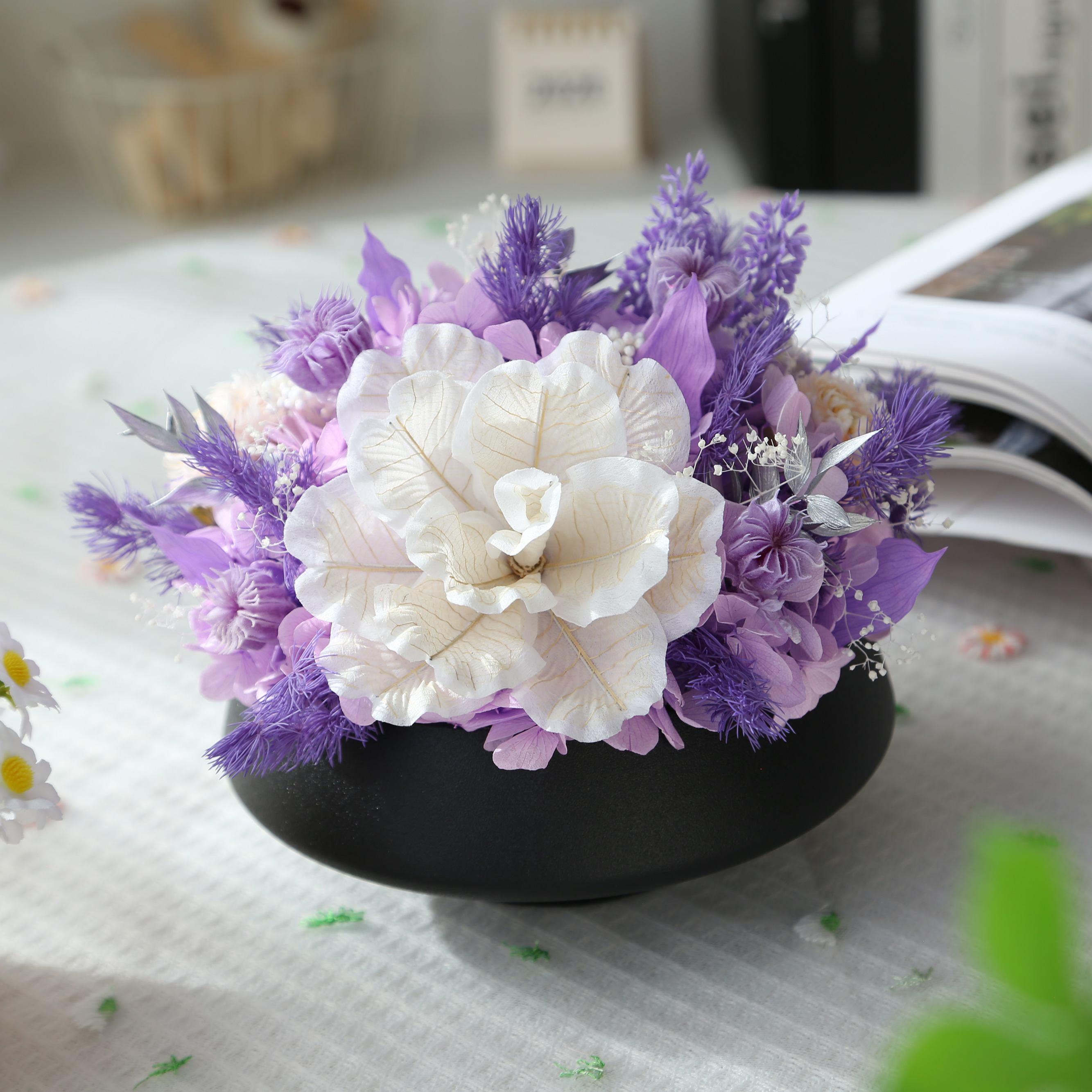
Run your fingertip across the back of a fresh maple leaf and you'll feel the raised architecture beneath the surface—the midrib like a shallow trench, the lateral veins branching at uneven angles, the finest network dissolving into barely-there ridges. Hold it up to afternoon light and those veins become a map of faint shadows, never perfectly symmetrical, often interrupted by small twists or a slight bulge where an insect once fed. Artificial plants that skip this complexity always read as plastic, no matter how vibrant the green. The ones that sell realness are the ones that reproduce not just the pattern but the inconsistency: a vein that wanders off course for two millimeters, a secondary branch that never quite reaches the margin, a tiny notch where the leaf folded during growth. These are the details nobody consciously inventories, but everyone's eye knows.
Sap marks are even easier to fake badly and harder to fake well. On a living leaf, dried sap rarely appears as a uniform droplet. It might be a translucent amber smear along the midrib, a faint crystalline dusting near a broken stem, or a dark oxidized streak following a damaged vein. Craftspeople who study real specimens learn to replicate the way sap behaves with gravity and surface tension—how it pools slightly on the underside of a leaf before drying into a thin film, how it leaves a halolike stain on surrounding tissue. Some use diluted resin brushed on in layers, others mix beeswax with pigment and apply it with a fine needle. The goal isn't to add a shiny blob; it's to suggest a story: this leaf once bled a little, then the wound sealed over. That narrative is what makes a buyer pause and reach out, convinced the object in front of them once drew water from soil.
Cheap imitations get this wrong in two opposite directions. Either they ignore sap marks entirely, leaving leaves that look vacuum-formed and sterile, or they dump a glossy dot at the exact center of every leaf, like drops of clear nail polish. Realness lives in the quiet middle: a few thin lines of dried exudate near the petiole, a subtle darkening along one edge of a vein, a tiny speck of amber caught in a vein axil. The best artisans will sometimes introduce a deliberate flaw—a half-eaten margin or a crinkled leaf tip—because they know perfection is the enemy of belief. When a customer sees a leaf with a slightly off-center vein and a faint residue trail that could only have come from a living system, they don't analyze it; they just feel it. And that feeling, more than any color or texture, is what closes the sale.
Color Gradients Borrowed from Sun and Soil
The palette begins where the horizon meets the earth—a slow burn of ochre and amber, as if the sun itself had dripped into the clay. These gradients don't shout for attention; they settle into the surface like late afternoon light across a dry riverbed. Hues shift from burnt sienna to pale wheat without a hard edge, mimicking the way heat softens every boundary. It's a quiet, mineral warmth that feels less designed and more discovered.
Pull deeper and you'll find the soil's own spectrum: deep umber folding into rust, then lifting into a dusty rose where iron and limestone have weathered together. The transitions carry a roughness, a lived-in patina that refuses to look polished. There's no clean digital fade here—instead, the colors blend with the irregular rhythm of windblown sand or a cracked adobe wall, giving each gradient a hand-mixed, almost accidental character.
Used across a space or a single surface, these borrowed gradients act like a record of the day's heat. Shadows take on a violet-brown undertone, highlights glow with the faintest apricot, and the mid-tones hold a gritty neutrality that anchors everything else. The result is a color story that feels elemental: not painted for effect, but unearthed from the very ground beneath our feet.
The Heft and Texture of Stems That Feel Alive
There’s a quiet deception in how we talk about plant stems. We call them rigid, woody, sometimes brittle — as if they were little more than scaffolding dressed in green. But run your fingers along a young rose cane or the ridged stalk of a sunflower and the story changes. The surface holds a slight give, a faint warmth that surprises the skin. Tiny hairs catch the light and your touch. It isn’t the smooth plastic of a fake stem, nor the dead snap of a twig long fallen. It’s something closer to a held breath.
That sense of aliveness comes through in the weight, too. A stem cut fresh from the garden doesn’t just rest in your palm — it leans, it balances, it carries its own architecture. The heft tells you about water moving through unseen channels, about cells still swelling and shrinking with the day’s humidity. Even after cutting, the stem keeps time differently than the flower it supports. Squeeze it gently between thumb and forefinger and you might feel a faint resilience, a refusal to collapse into mush. That tension is the plant’s last argument against being called an object.
Texture adds another layer of honesty. Some stems are cool and smooth like polished jade; others are furrowed, corky, or dusted with a bloom you can rub away with one pass. Each ridge and groove is a record — of growth spurts, of drought, of wind pressing the plant toward one side. When a stem feels alive, it doesn’t just sit there. It registers your presence. It warms where you hold it. It leaves a faint green scent on your skin, as if to remind you that the line between plant and hand is thinner than you thought.
Arrangements That Look Better Than the Real Thing on Camera
Some of the most photogenic centerpieces are not living at all. High-quality silk peonies and faux eucalyptus hold their shape under hot studio lights, while real blooms wilt before the shoot ends. Their colors stay saturated hour after hour, which is why stylists often swap fresh flowers for fabric versions when the camera needs a flawless close-up.
Faux fruit and ceramic vegetables are another quiet secret. A bowl of wax apples or resin lemons catches light without bruising, sweating, or turning brown at the edges. Even in a wide shot, these stand-ins read as fresher than the real produce sitting next to them, simply because they never change under prolonged exposure.
The same logic applies to bookcase styling and table spreads. Resin honeycomb, acrylic ice cubes, and foam moss add texture without the mess of drips or melting. For a camera that magnifies every flaw, these impostors deliver a consistency that living materials rarely match.
How to Spot Faux Blooms That Even Florists Double-Take
Real petals tend to have subtle irregularities—tiny veins, a gradient that shifts under different light, edges that aren't perfectly uniform. If every blossom on the stem looks suspiciously identical, run your thumb along the outer edge. Silk and latex often feel too smooth or slightly grippy, while fresh petals bruise or curl just a touch when you press. The quickest giveaway? Sniff the center. Many faux blooms carry a faint plastic or chemical note up close, even those marketed as "real touch," and no amount of floral perfume hides that stale, flat undertone.
Another trick florists use is to check the stems and leaves, not the flowers. Real stems are rarely straight as dowels; they have nodes, tiny nicks, or a faint fuzz where leaves attach. Faux versions often mimic the bloom beautifully but fall apart on the greenery—leaves may be glued in with visible residue, cut ends show a hollow plastic shaft, or the foliage has a uniform gloss that real leaves only get right after rain. Bend a leaf gently. If it creases like paper or snaps back without a trace, it is not photosynthesizing.
FAQ
Peonies, ranunculus, and garden roses tend to fool people because their petals have irregular, layered edges that hide the synthetic texture. Look for stems with varied bud sizes, slightly bent leaves, and color gradients rather than one flat tone. If you trim the stems to different lengths and put them in a cloudy glass vase, most guests won't think twice.
Check the leaves and stems first. Cheap faux flowers usually have shiny, plastic-looking greenery and perfectly uniform wire. Higher-quality pieces use matte latex or crushed polyester petals, wired stems that hold a natural curve, and hand-painted color details. Also, avoid anything with visible glue blobs where the petals meet the calyx.
Yes, some of the best faux succulents and orchid stems can fool people who grow the real ones. For succulents, the giveaway is usually weight and a too-perfect rosette, but if you add a little real soil or pebbles to the pot and vary the leaf coloring, they pass easily. For orchids, look for silk blooms with airbrushed throats and slightly drooping petals rather than stiff upright ones.
Use a cool hair dryer on low to blow off loose dust, then wipe each leaf with a barely damp microfiber cloth. For intricate flowers, a soft paintbrush works well. If they're fully submersible, you can swish them in lukewarm water with a drop of mild dish soap, rinse, and let them air-dry upside down. Do this every few months and they'll keep that just-bought look.
Yes, and that's one of the best tricks for making faux flowers look real. Put realistic silk stems like sweet peas or lisianthus among fresh eucalyptus, dusty miller, or ferns. The real greenery gives off a light natural scent and has slight imperfections, which pulls the eye away from the fake blooms. Just make sure the real stems are in water and the faux ones are kept dry.
For weddings, stick to soft, organic-looking blooms like garden roses, peonies, ranunculus, and anemones with dark centers. White and blush varieties are easiest because they don't need as much color depth as bold reds or purples. Ask for UV-stable silk if any ceremony or photos will be outdoors, and swap shiny ribbon or plastic fillers for real greenery or dried grasses.
If you want them to last for years and be handled or rearranged often, yes. High-end faux flowers usually have wired stems with fabric-wrapped joins, fade-resistant dyes, and petals that bounce back after being packed away. Cheap ones can look okay from across the room but show their flaws up close. Think of it like buying a good wig versus a costume wig—the price difference is visible.
Conclusion
The most convincing faux stems on the market don't just mimic petals from a distance—they hold up to close inspection. Silk blends are often cut with a slight irregularity along the edges, and the veins pressed into each leaf carry tiny, almost imperceptible sap marks that catch light the way a living plant would. Color is another tell of careful work: instead of flat, single-tone washes, the best pieces borrow gradients from sun-faded tips, soil-darkened bases, and the uneven blush that comes from a real garden. Even the stems matter. A well-made artificial flower will have weight and a slightly rough, fibrous texture under your fingers, not the hollow plastic feel of cheaper versions. Bend a stem and it should resist just enough before giving, much like a fresh cutting.
Once arranged, these high-end faux blooms can actually outshine real flowers in photographs, where their color stays saturated and their shape never wilts under hot lights. The trick to spotting them, even for experienced florists, often comes down to repetition—real stems vary leaf by leaf, while even the best artificials repeat a pattern if you look long enough. But that repetition is rarely noticed at a glance. The real giveaway is usually the cut end or the joint where a leaf meets the stem; top makers now hide those seams inside natural-looking nodes. So if you want a centerpiece that fools the eye from across the table and holds up in every snapshot, focus on those details: petal irregularity, sap-like residue, gradient coloring, and stems that feel alive in your hand.
Contact Us
Contact Person: Mr. Luo
Email: [email protected]
Tel/WhatsApp: 86 18100895505
Website: https://www.feiliyaflowers.com/en/