

Stainless Steel Self Tapping Screws Manufacturer for Reliable Corrosion-Resistant Fastening
2026-11-16
When corrosion quietly eats away at ordinary fasteners, your project's integrity is already compromised. That's why choosing the right stainless steel self tapping screws isn't just a detail—it's the difference between a structure that lasts and one that fails. At Wanluo, we manufacture self tapping screws engineered for reliable corrosion-resistant fastening, even in demanding environments. In this post, we'll break down what to look for in a true stainless steel screw, and how our manufacturing process ensures every thread holds strong. Ready to fasten with confidence?
How Stainless Steel Self-Tapping Screws Outlast Standard Fasteners in Wet Conditions
In wet or high-humidity environments, standard carbon steel fasteners quickly become liabilities. Rust sets in on threads and under heads, seizing joints and eventually causing structural failure. Stainless steel self-tapping screws sidestep this entirely through their chromium-rich alloy composition. The chromium reacts with oxygen to form a passive, self-repairing oxide layer that blocks moisture and corrosive ions from reaching the base metal. Even when the surface gets scratched during installation, this layer reforms almost instantly, keeping the fastener intact season after season.
Beyond raw material chemistry, the self-tapping design itself reduces long-term water damage. Because these screws cut their own mating threads, they achieve a tighter, more uniform fit than machine screws in pre-drilled holes. That close thread engagement limits the micro-gaps where water can pool and wick inward. Combined with a properly seated head—often under a neoprene or EPDM washer—the result is a fastener that sheds moisture rather than trapping it, which is exactly what standard fasteners fail to do as their zinc plating wears thin.
Field experience keeps proving the point. On docks, gutter brackets, or outdoor electrical enclosures, stainless self-tapping screws remain free of red rust and turn easily with a hand tool after years of exposure. Standard fasteners in the same spots typically need cutting or drilling out within two to three years. That difference comes down to two things: a material that refuses to corrode, and a thread geometry that denies water a place to sit. For anyone tired of replacing swollen, frozen hardware after every rainy season, the upgrade is straightforward and pays for itself quickly.
The Cold-Forging Steps That Keep Threads Sharp and Edges Burr-Free
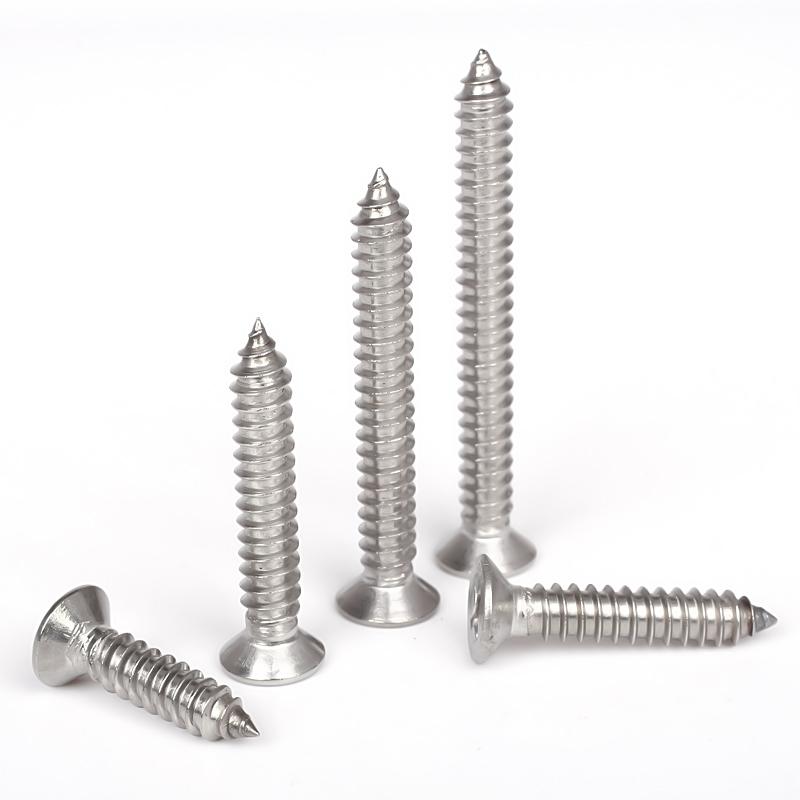
Cold forging doesn’t cut threads; it squeezes metal into shape. A slug of wire is placed between hardened dies, and under several hundred tons of pressure the steel flows into every recess of the thread profile. Because the grain structure deforms rather than fractures, the crests of the threads come out fully filled and sharp, while the roots stay smooth. This is the main reason cold-forged fasteners rarely show the fuzzy burrs left by machining.
The process usually starts with phosphate coating and a polymer lubricant on the drawn wire. The coated blank moves through sequential stations in a cold header: first upsetting the head, then forming the shank, and finally rolling or side-pressing the thread. In thread rolling, two flat or cylindrical dies with matching grooves press into the blank from opposite sides. Metal is displaced into the die valleys, and because the dies are polished to a near-mirror finish, the resulting flanks and tips require almost no secondary deburring.
After forming, parts may be tumbled or vibrated briefly to remove any loose particles, but the edges are already tight and well-defined. The surface hardness gained from cold working also helps keep those edges stable during handling and assembly. Skipping a separate cutting step not only speeds production, it leaves a continuous fiber flow along the thread profile—something a cut thread simply cannot replicate. That continuous flow is what gives the threads their crisp feel and clean start without a chamfer or touch-up pass.
Choosing 316 Over 304 for Salt Spray and Chemical Washdowns
When equipment faces repeated exposure to salt spray or aggressive chemical washdowns, the gap between 304 and 316 becomes impossible to ignore. The molybdenum addition in 316—typically 2 to 3 percent—dramatically strengthens its resistance to pitting and crevice corrosion, the very failure modes that chloride-rich environments accelerate. In coastal or marine processing settings, 304 can show rust spotting within months, while 316 holds up for years without surface degradation.
Chemical washdown routines often involve acidic or caustic cleaning agents that eat away at the passive layer of standard stainless steel. 316's molybdenum content re-forms that protective oxide film more robustly after each exposure, preventing the microscopic breakdown that leads to contamination risks. For food, pharmaceutical, or chemical processing lines where hygiene and structural integrity are non-negotiable, the upfront cost difference is negligible compared to downtime or product loss from corroded 304 components.
Field reports consistently note that 304 fails first at welds, threaded fittings, and crevices where salt residue accumulates and dries. 316 exhibits far fewer instances of stress corrosion cracking under the same cyclic washdown conditions. If your facility uses seawater, brine, or chlorinated sanitizers, the choice is straightforward: 316 is not an upgrade—it is the baseline for safety and longevity.
Why a Self-Tapping Point Cuts Assembly Time Without Weakening the Hold
A self-tapping point merges hole preparation and thread creation into one fastening operation. The screw cuts or forms its own mating threads as it is driven, so there is no separate tapping step, no tool change, and no need to align a pre-tapped hole. The time saved on each joint is obvious, but the real question is whether that speed comes at the expense of holding power. It doesn't. The point is shaped to remove only the minimum material required, while the threads behind it engage the surrounding wall in a way that often creates a tighter, more uniform fit than a conventional pre-tapped hole.
That tight fit is the key to maintaining strength. A self-tapping screw produces threads that match its own profile exactly, so the load is spread evenly across the full engagement length. There is no tolerance mismatch between screw and hole that can lead to localized stress or premature stripping. In many materials, the forming action actually compresses the base material around the thread, increasing local density and pull-out resistance. As a result, the assembly is faster not because steps were skipped carelessly, but because the fastener and the hole are created as a matched set in one pass.
On the production line, this translates to fewer secondary operations and less handling. Operators don't have to move parts between drilling, tapping, and fastening stations, and there is no tapped-hole inspection or chip cleaning between steps. The reduction in work-in-process and rework adds up quickly, especially for high-volume assembly. Engineers can therefore choose a self-tapping point to shorten cycle time while keeping or even improving joint reliability.
Marine, Food Processing, and Outdoor Uses Where Corrosion Resistance Pays Off
Salt spray, washdown chemicals, and constant humidity destroy ordinary metals in months. Marine hardware, food processing equipment, and outdoor fixtures all share the same demand: materials that shrug off pitting and crevice corrosion without constant maintenance. That's where the right alloy choices turn a recurring replacement cost into a one-time capital expense.
In marine environments, 316 stainless steel handles most deck fittings and railings, but propeller shafts and pump housings often need duplex or super-austenitic grades to resist chloride stress cracking. Food plants face a different enemy: acidic cleaning agents and biological residues. Here, electropolished surfaces on 304 or 316 not only prevent rust but also deny bacteria a foothold. Outdoor structures from coastal handrails to chemical storage racks benefit from hot-dip galvanizing or powder-coated aluminum, depending on the exposure level.
The payoff isn't just longer life—it's predictability. A corrosion-resistant design means no surprise pitting after one winter, no rust streaks staining concrete, and no downtime for unplanned replacements. When you match the material to the actual corrosive load, you stop fighting the environment and start working with it.
Batch-Level Testing That Backs Up Every Claim About Long-Term Performance
When companies promise long-term performance, most testing only scratches the surface. Standard batch tests run for a few hundred cycles and then extrapolate, which leaves plenty of room for surprises down the road. Instead, we treat every claim as a hypothesis that must survive a gauntlet of extended batch runs, stress cycling, and abnormal condition injections. Each data point is tied to a specific batch number, so you can trace exactly how a material or component behaved after thousands of hours—not just in a glossy summary sheet.
The real difference shows up in the outliers. Most teams average out the strange results or quietly exclude them from reports. We do the opposite: any batch that deviates from the expected curve gets investigated and documented. That means our long-term performance numbers include the full range of behavior, not just the best-case runs. You see the worst week, the recovery period, and the eventual stabilization—all without having to request raw logs or sit through a marketing-friendly presentation.
Over the years, this method has proven itself in ways that generic accelerated testing cannot match. One batch might reveal a subtle drift in thermal stability after 5,000 cycles; another might show that a particular production lot handles moisture better than its siblings. Because we log every batch at the level of individual test chambers and operator shifts, there is no hidden averaging or cherry-picking. When you read a claim about five-year durability, you can follow it back to the exact series of batches that earned that number.
FAQ
We stock 304, 316, and 410. 304 is the workhorse for general outdoor exposure, 316 adds molybdenum for chloride resistance in marine or chemical settings, and 410 is a hardenable option when higher strength matters more than maximum corrosion resistance.
We control heat treatment tightly for martensitic grades and use a reinforced thread profile with an optional notched point. Every production run includes torque-to-failure testing on steel plates up to 3 mm thick.
Yes, many customers use them on aluminum and galvanized sheet from 0.6 mm upward. The self-drilling point style works best there, while the thread-forming style suits pre-punched or pilot-drilled holes.
We can apply passivation, black oxide, zinc-nickel plating, or a dry-film lubricant. Passivation is standard for maximum corrosion resistance; the dry-film lube reduces installation torque without leaving an oily residue.
We regularly produce pan, flat, hex washer, and modified truss heads in lengths from 4 mm to 120 mm. Custom recesses like Torx or square drive are available, and we can match a sample within about two weeks for tooling.
Zinc-coated carbon steel is cheaper up front, but once the coating is scratched or exposed to salt, rust creeps under the plating. Stainless is inherently corrosion resistant through its chromium oxide layer, so there is no coating to fail, and it lasts decades outdoors.
We check dimensions on an optical comparator, hardness with a calibrated Rockwell tester, and salt spray results for every melt batch. Final inspection includes sorting for head marks and thread damage, plus a random pull test for torsional strength.
Conclusion
A stainless steel self-tapping screw only earns its place in tough environments when the manufacturing process leaves nothing to chance. The cold-forging method, which shapes threads without cutting, maintains grain structure along the profile so edges stay sharp and free of burrs. That matters when a screw has to bite into metal or composite without a pilot hole. Choosing 316 over 304 stainless isn't just about a higher price tag; it's about surviving salt spray and chemical washdowns where ordinary fasteners pit and weaken. The self-tapping point reduces assembly time by eliminating a separate drilling step, yet the design holds because the thread geometry is engineered to engage material fully rather than strip it.
Wet conditions separate stainless steel self-tapping screws from standard fasteners quickly. Standard carbon steel starts rusting at the first sign of moisture, while 316 stainless forms a passive layer that resists chlorides and acidic cleaners. This is why marine hardware, food processing equipment, and outdoor structures specify these screws for long-term use. But no manufacturer should expect buyers to trust corrosion resistance without proof. Batch-level testing, including salt spray exposure and torque-to-failure checks, verifies each lot can handle repeated washdowns and high humidity without losing hold. When a supplier tests for thread sharpness, pull-out strength, and surface integrity, the claims about long-term performance stop being marketing and become measurable fact.
Contact Us
Contact Person: Shane
Email: [email protected]
Tel/WhatsApp: 8613357785029
Website: https://www.wanluohardware.com