
OEM Vertical Lift Rack Zinc Plating Equipment What to Know Before Buying
2026-08-19
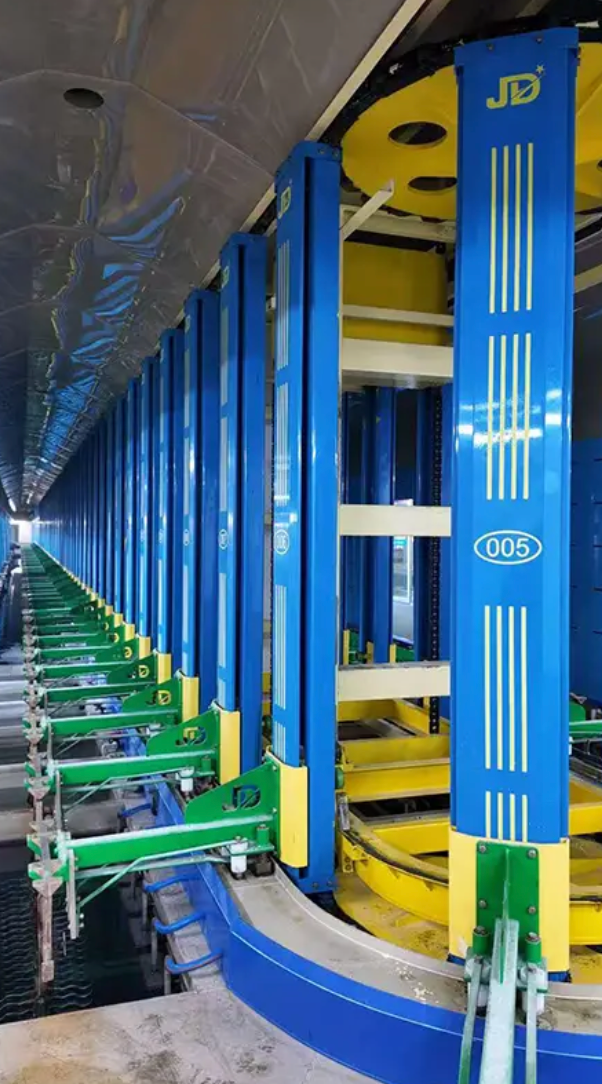
Choosing OEM vertical lift rack zinc plating equipment isn't just about finding a machine that fits your floor space. It's about line speed, load capacity, and whether the control system will still make sense three years from now. Too many buyers focus on upfront cost and miss the design details that lead to downtime and rework. At Junda, we've learned exactly which questions separate a smart purchase from an expensive mistake. Here's what to know before you buy.
Is Your Plating Line Ready for a Custom Vertical Lift Rack?
If your operators are still muscling heavy parts onto generic racks or shimming odd geometries with scrap wire, the line is telling you something. Custom vertical lift racks earn their keep the moment the load stops shifting mid-tank and plating thickness stops varying across a batch.
Before you order, look at your current rack-to-part ratio. Are you running half-empty bars because nothing quite fits? Do certain part numbers have to wait for a borrowed rack? That kind of bottleneck is rarely solved by another off-the-shelf frame. A rack built around your largest recurring part family—while leaving room for mixed loads—turns changeover time into productive tank time.
Also check your lifting points. A vertical lift rack should balance the full wet load without twisting, especially on automated hoist lines. If you are adding counterweights or slowing the line to keep racks from swinging, the custom route is already overdue.
Load Ratings and Safety Margins Most Buyers Overlook
When comparing lifting equipment, the first number everyone checks is the rated load capacity. But that figure alone tells only part of the story. The real difference between a safe operation and a dangerous gamble often lies in the safety margin engineered into the product. Many buyers fail to ask how the rating was derived—was it based on a destructive test, a calculated formula, or a conservative derating? Without that context, two pieces of equipment with the same printed capacity can behave very differently under real-world stress, especially when loads shift or the lift angle changes unexpectedly.
Safety margins are not a sign of overbuilding; they are a buffer against the unpredictable. A hoist or rigging component rated at one ton might actually break at three tons, giving you a 3:1 margin. But some imports cut that margin dangerously thin to shave cost, leaving almost no room for dynamic forces, worn parts, or imperfect rigging geometry. Smart buyers look beyond the sticker and request the test certificate, the standard used, and the actual breaking strength. If a seller hesitates to share that data, that silence is often the loudest warning.
Another overlooked factor is how the rating changes with configuration. A shackle rated for 4.75 metric tons with the pin vertical can drop to a fraction of that when loaded at a 45-degree side angle. Similarly, a chain sling's capacity shifts dramatically depending on the hitch type—straight pull, choker, or basket. These de-rating rules are written in standards like ASME B30.26, but far too many buyers stop at the headline number and never read the footnotes. If you want equipment that protects your crew, start by demanding the full load chart and then test your own assumptions against it, because the margin you think you have might only exist on paper.
Zinc Thickness Alone Won't Save a Poorly Welded Frame
It is easy to assume that a heavy zinc coating is the ultimate shield for any steel frame, but that assumption crumbles when the welds are substandard. A thick layer of zinc can hide a multitude of sins on the surface, yet it does nothing to reinforce a weak, porous, or undercut weld joint. Once stress or vibration works on the frame, those hidden defects become the first points of failure, and the zinc layer simply peels away or cracks along the weld line, exposing bare steel to rapid corrosion.
Poor welding creates uneven surfaces, spatter, and tiny fissures that disrupt the continuity of the galvanized coating. Zinc cannot bond effectively to areas with slag inclusions or sharp notches, leaving microscopic gaps where moisture and oxygen can settle. Over time, corrosion starts inside these voids and spreads beneath the zinc, often invisible until the coating bubbles or flakes off. In contrast, a clean, properly fused weld provides a smooth, uniform substrate that allows the zinc to adhere evenly and perform its sacrificial protection as intended.
When evaluating a galvanized frame, do not let a high zinc thickness reading distract you from inspecting the weld quality. Look for consistent bead profile, full penetration, and the absence of undercut or cold lap. Only when the welding is structurally sound can the zinc coating serve as a reliable second line of defense. Otherwise, the frame will fail long before the zinc layer has a chance to wear away naturally.
Hydraulic or Pneumatic Drives and Why It Changes Maintenance
Switching from electric motor drives to hydraulic or pneumatic systems reshapes the maintenance workload in ways that go far beyond a simple swap of components. Instead of routine bearing lubrication and insulation checks, you're suddenly managing fluid cleanliness, filter replacement schedules, and the constant hunt for microscopic leaks. Hydraulic systems are especially unforgiving: one contaminated batch of oil can destroy pumps and valves, so sampling and filtration become daily habits. Pneumatic drives trade oil spills for air leaks and moisture buildup, which means draining water separators and adjusting lubricators becomes part of the standard walkaround.
The way failures develop also changes the maintenance approach. Electric motors often work normally until they stop, but hydraulic drives degrade in measurable ways—pressure drops, cylinder drift, or rising oil temperature offer early warnings if you track baseline data. Pneumatic actuators tend to fail more suddenly when seals wear out, yet they are usually cheaper and faster to replace. This pushes the team away from blind calendar-based replacements and toward condition monitoring, trend analysis, and listening carefully to operator reports about changes in speed, noise, or push force.
There's also a practical shift in housekeeping and safety routines. Hydraulic equipment demands regular degreasing of floors and guarding against oil mist, which creates slip hazards and fire risks. Pneumatic systems keep the area cleaner but add noise concerns and the danger of loose fittings becoming projectiles. Choosing between hydraulic and pneumatic power ultimately determines the tools, training, and daily inspection habits your maintenance crew needs to stay ahead of failures rather than reacting to them.
How OEM Fit-Up Affects Drainage and Drying Time
The precision of OEM fit-up plays a direct role in how quickly water leaves a system. When components align exactly as designed, the internal pathways remain clear and unobstructed, allowing gravity to do its work without fighting irregular edges or misaligned seams. Even a tiny gap or offset can trap moisture in unexpected pockets, turning a quick drain cycle into a prolonged wait.
Beyond the obvious blockages, subtle mismatches in fit-up create surfaces where water lingers as a thin film. This film evaporates far more slowly than pooled water because it has a larger surface area relative to volume and clings to micro-crevices. Over time, these lingering damp zones extend the overall drying time and can lead to localized corrosion or microbial growth if not addressed.
In contrast, a well-executed OEM fit-up promotes laminar flow and clean breakaway of water. The engineered tolerances leave no place for capillary action to hold droplets, so the equipment reaches a dry state sooner. For operators, this means less downtime between cycles and fewer manual drying steps, directly improving throughput without extra labor.
Control Integration With Existing Hoists and PLCs
Bringing a new control layer into an existing hoist setup rarely means ripping out the PLC that already runs the line. More often, it comes down to reading the right tags, mapping discrete I/O, or passing simple ASCII strings over a serial link. Older hoists may only expose run, stop, and brake contacts; newer ones might offer EtherNet/IP or Profinet with explicit assemblies. The integration work is mostly about matching those signals to what the new controller expects and keeping the scan times realistic.
One of the first checks is whether the hoist's existing PLC treats the external controller as a peer or as a master. In many plants, the hoist PLC owns motion and safety, while the new system sends high-level commands like target floor, creep speed, or pause. That boundary has to stay clean. If the hoist still relies on relay logic, an intermediate remote I/O block or a small protocol converter can bridge the gap without forcing a PLC rewrite.
Commissioning usually exposes timing mismatches rather than wiring mistakes. A hoist may take 800 milliseconds to confirm brake release, while the new controller times out at 500. Adjusting those timers, adding handshakes for each motion command, and verifying fail-safe behavior when communication drops are often more valuable than trying to unify everything onto one bus. The goal is a control interface that respects the hoist's existing safety routines instead of working around them.
FAQ
Vertical lift racks hold individual parts on fixtures or hooks and move them straight up and down through the plating bath. Barrel systems, by contrast, tumble parts inside a rotating cylinder. That means racks give you better control over coating thickness and reduce part-to-part contact, so they're the better choice for larger, fragile, or high-spec components.
Parts with complex geometry, tight dimensional tolerances, or surfaces that can't tolerate dents and dings usually belong on racks. Think brackets, shafts, long extrusions, or components with threaded holes. If your parts are small and robust enough to be processed in bulk, a barrel might be cheaper, but racks win when surface finish and consistency matter.
Start with the largest part you plan to plate and work backward to the rack frame, hoist rating, and tank depth. Don't just look at total weight; think about current density distribution and how parts hang. A rack that's overloaded or too tightly spaced will cause uneven plating, burning, or poor coverage in recessed areas.
The rack structure needs to resist both chemical attack and electrical current demands. Look for stainless steel or copper-core racks with a protective PVC or Plastisol coating on areas that shouldn't plate. Bare metal contact points, usually stainless or titanium tips, are what carry current to the parts, so they need to be replaceable and properly sized for the amperage.
If your parts vary a lot in size or you have specific throughput targets, custom usually pays off. A standard line might fit a narrow range of products, but you'll spend more on rework and handling when something doesn't fit. Custom OEM lines let you match tank layout, hoist speed, and rack spacing to your actual part mix rather than forcing your parts into someone else's design.
Plan on regular inspections of rack coatings, contact tips, hoist chains, and rectifier connections. Zinc plating baths are corrosive, so stripped or cracked rack coating will plate onto the rack itself and steal current from your parts. Most shops get into trouble by ignoring small insulation failures until they cause big quality problems.
Look for programmable hoist controls that let you adjust dwell time, transfer speed, and drip time per station. Rectifiers with current control and ripple monitoring help keep zinc thickness consistent. Also, make sure the control panel gives you straightforward fault alerts—if you have to guess why the line stopped, downtime gets expensive fast.
For a typical single-hoist line, budget four to eight weeks on-site after delivery, depending on tank layout and facility readiness. Commissioning usually adds another one to two weeks for process tuning and operator training. If you're adding wastewater treatment or new chemical systems at the same time, the timeline can easily double.
Conclusion
Before committing to an OEM vertical lift rack for zinc plating, look beyond the shiny spec sheet. A custom rack only earns its place if your existing line layout and tank geometry actually match the manufacturer’s lift envelope. Too many buyers wind up shimming rails or cutting access holes because nobody checked corner clearance against carrier arms. Load ratings deserve equal scrutiny: the static weight of a full parts basket is one thing, but the shock of a jerky hoist start multiplies that force. Ask for the dynamic load figure and leave a real safety margin, not just the bare minimum stamped on the data plate. And remember that heavy zinc coating won’t hide a weak frame. Inspect welds at the gussets and cross-brace junctions—cold lap or undercut there means the rack flexes, and flexing throws off anode-to-part spacing.
Drive type changes your maintenance routine more than most salespeople admit. Hydraulic cylinders give smooth, high-force lifting but need hose inspections, fluid changes, and occasional seal rebuilds; pneumatic drives are simpler and cheaper to service, yet they can chatter under uneven loads. If your shop already runs hoists off a PLC, insist on a rack controller that speaks the same protocol—retrofitting a standalone pendant adds operator confusion and safety risk. Fit-up also decides how fast parts drain. A rack whose saddles trap water or whose uprights block airflow can double drying time even with the right zinc thickness. Look for slotted contact points and open-channel uprights, and confirm the manufacturer tested the assembly with your actual barrel or rack style, not just a generic drawing.
Contact Us
Contact Person: hayyr
Email: [email protected]
Tel/WhatsApp: 8613082110525
Website: https://www.jundaelectroplating.com