

Hybrid Servo Press Brake Manufacturer: Key Factors for Precision Bending
2026-10-06
Every shop has felt the sting of a bend that's just half a degree off. It's not just wasted material—it's lost time, lost trust, and a hit to the bottom line. That's why the choice of hybrid servo press brake manufacturer matters more than most realize. HUNSONE approaches precision bending with an engineer's obsession, not a salesperson's checklist. But what actually drives repeatable accuracy? Before you sign off on another machine, there are a handful of critical factors worth examining—and they're rarely found on a spec sheet.
What Hybrid Servo Control Actually Changes on the Shop Floor
The most immediate change is that operators stop chasing pressure and flow settings. A hybrid servo drive reads the actual load from the motor torque and adjusts oil delivery in real time, so a press brake bending 16-gauge stainless doesn't need the same manual valve tuning as one working with 10-gauge mild steel. Tool wear and oil temperature no longer force a mid-shift recalibration; the control loop absorbs those drifts before they become scrap parts.
Energy use drops in a way you can feel on the floor. Instead of a fixed-speed pump dumping excess flow over a relief valve, the servo motor ramps down between strokes, so the machine runs cooler and quieter. That surplus heat used to radiate into the shop and shorten hose and seal life; now the hydraulic reservoir stays lukewarm even on a double shift, and the chiller cycles far less often.
Maintenance patterns shift from component replacement to condition monitoring. With fewer high-pressure hoses seeing constant spikes and the pump no longer idling at full rpm, leaks and seal failures become less frequent. And because the drive logs load signatures, a maintenance tech can spot a degrading cylinder seal or a worn tool from the torque trace before it turns into unplanned downtime.
Why Frame Geometry Beats Raw Tonnage for Repeatable Angles
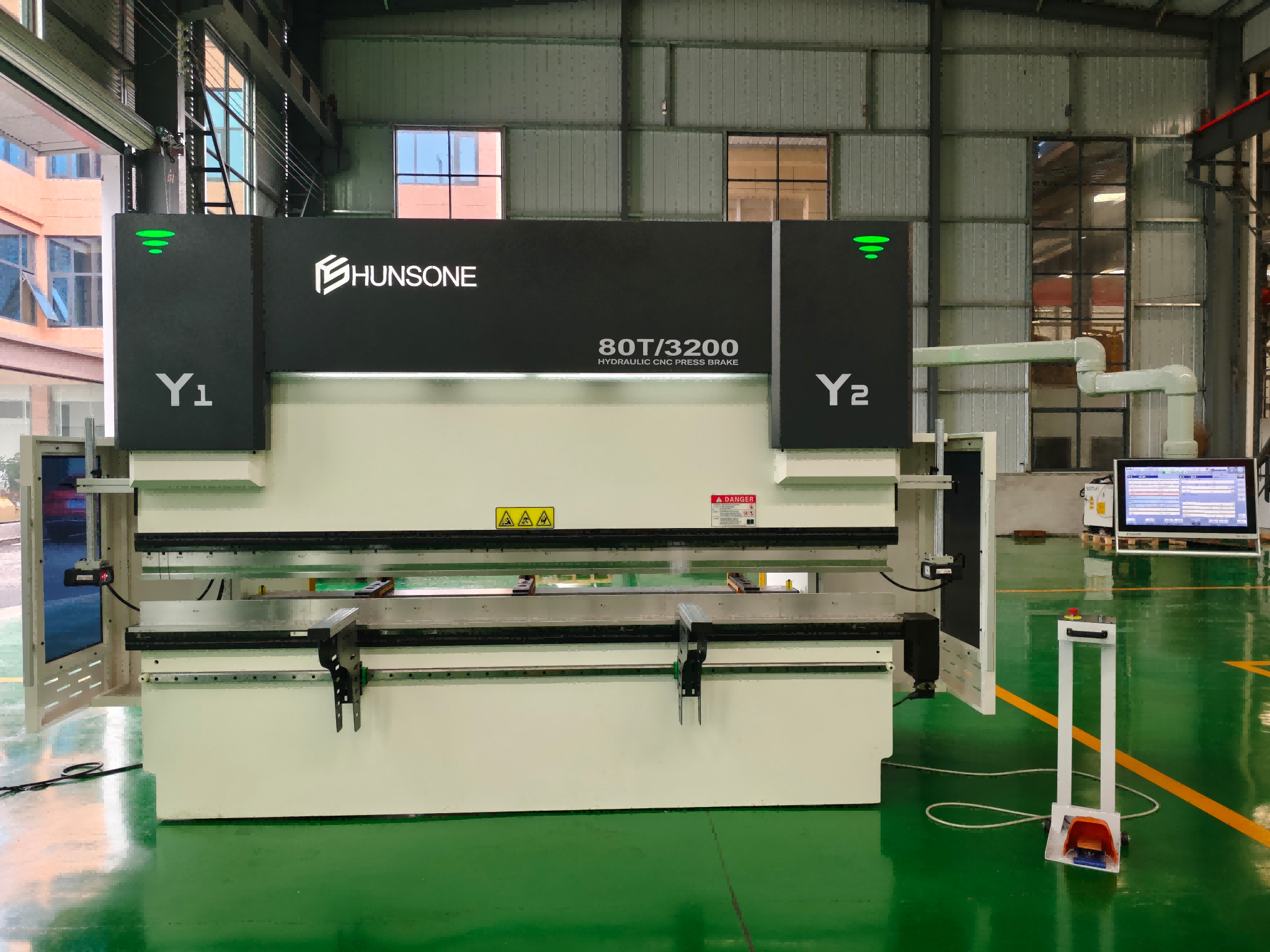
Most fabricators assume that if a press brake has enough tonnage, it can hold any angle. That logic falls apart when the workpiece springs back or when the ram flexes under load. Frame geometry matters more than brute force because the distance between the side housings, the throat depth, and the crowning system all determine how evenly the force distributes across the bend. A machine with a short, stiff frame can out-bend a heavier unit that twists under partial loads.
Repeatability is not about hitting the angle once; it is about hitting it every single time without manual tweaks. When the frame deflects unevenly, the center of the die sees different pressure than the edges, so the angle opens up in the middle. A well-designed frame uses a deep bed and a balanced yoke to cancel out that deflection before it reaches the tooling. That is why shops chasing tight tolerances look at the distance between columns and the crown compensation curve, not just the tonnage sticker on the side.
Raw tonnage can actually work against you. Overpowered machines on a light frame create a spring effect, where the ram bounces slightly at the bottom of the stroke, leaving inconsistent bend angles. The smarter approach is to match the frame stiffness to the bending length. A narrower, beefier frame will repeat a 90-degree bend all day, while a wider, thinner frame might wander by half a degree after twenty parts. In the end, geometry is the silent partner that determines whether your angle stays put.
The Hidden Cost of Ignoring Ram Deflection Compensation
Most shops treat ram deflection compensation as a nice-to-have, right up until they notice the bend angle drifting across a long part. The ram bows under load, so the center of the workpiece gets a slightly different angle than the edges. You end up with parts that measure fine at one end and out of tolerance in the middle. That's not a material problem—it's the press telling you something.
Ignoring it doesn't just cost you a few scrapped blanks. Operators start shimming dies, swapping tooling, or chasing the angle with repeated hits, which eats time and inflates labor. Then there's the wear on guideways and tools because the frame isn't loading evenly. Over a year, those hidden hours and premature replacements add up fast, often exceeding what a proper compensation setup would have cost.
The fix can be as straightforward as retrofitting a hydraulic crowning system or choosing a machine that already includes active deflection control. Some shops still lean on manual workarounds, but that's a losing game when material prices and delivery windows keep tightening. Once you account for rework, inspection bottlenecks, and the slow erosion of customer trust, the real price of skipping compensation becomes impossible to ignore.
Tooling Fit-Up Tricks That Cut Setup Time in Half
Most shops accept slow tool changes as unavoidable downtime, but a few simple habits can slash that wait. Start by staging every gauge, wrench, and insert next to the machine before the spindle stops. Layout the exact sequence on a shadow board or magnetic strip so your hands move without thinking. This removes the “where did I put it” pause that eats minutes out of every job.
Another trick is to pre-set tool offsets on a bench block instead of touching off inside the machine. Use a height gauge with a dial indicator and record the numbers on a small whiteboard attached to the control. When the next job loads, just type in the stored values — no test cuts, no chasing tenths. It feels almost too simple, but it turns a twenty-minute fit-up into a two-minute entry.
Finally, group tools by family and keep a “next job” cart parked beside the machine. Pull end mills, collets, and holders for the upcoming work order while the current part runs. When the cycle ends, swap the old cart for the new one and go. You stop treating setup as a separate event and start treating it as a rolling handoff.
Reading a Manufacturer’s Test Bend Data Like a Pro
Most people glance at a bend test report, spot the pass/fail box, and move on. That’s like judging a race by only looking at the finish line photo. The real story lives in the numbers that don’t get circled in red. Look at the bend radius-to-thickness ratio first. A tighter ratio that passes tells you far more about ductility than a generous radius ever will. Also check the bend angle and whether the specimen was bent with the root or face in tension — orientation flips the failure mode completely.
Next, ignore the average values for a moment and hunt for outliers. One specimen that cracked at 120 degrees while three others bent to 180 without issue isn’t a fluke — it’s a warning sign about inconsistent material or a heat-affected zone that got too much heat. Pull the individual readings, not just the summary line. And don’t let the word “passed” silence your curiosity: a pass at the minimum required angle means something very different from a pass at double that angle. The margin is the message.
Finally, cross-reference the bend data with the tensile and hardness values from the same test lot. If elongation is high but the bend test barely squeaks through, suspect surface condition or notch sensitivity. If hardness spikes in the bend zone, you’re probably looking at strain aging or excessive cold work before welding. Reading like a pro means treating the bend report as one frame in a film strip, not a standalone snapshot.
Springback Isn’t Constant—Here’s How Smart Press Brakes Adapt
Ask any experienced operator and they'll tell you the same thing: the springback you measured on Monday's 304 stainless won't match what you see on Wednesday, even if the thickness and grain direction look identical. Heat from earlier jobs, subtle differences in coil certification, and even ambient shop temperature all nudge the material's yield behavior, so a fixed angle correction quickly becomes a guess.
Smart press brakes stop treating springback as a single stored number. They read the actual forming load during the bend, compare it against a live material model, and adjust the target angle before the ram reaches the bottom. Some systems also factor in tool deflection and the way the sheet was cut, because a laser-cut edge can respond differently than a sheared one.
That continuous feedback loop changes what the operator has to monitor. Instead of chasing a correction table after every batch, the control handles the drift and flags only the parts that fall outside a confidence window. The result isn't just fewer rejected pieces—it's a bending process that finally matches the reality of metal, not the assumption of a constant.
FAQ
A conventional hydraulic system keeps pumping fluid even when the ram is idle, which steadily warms the oil and causes thermal drift in beam position. A hybrid design pairs an AC servo motor with a hydraulic pump that delivers flow only when the ram actually moves. That keeps oil temperature much more stable, so the Y-axis stays repeatable over long shifts and you spend less time chasing angle drift.
The frame rigidity and the crowning system usually make the biggest difference. If the bed or ram deflects under load, the middle of the part bends to a different angle than the ends. Look for a well-ribbed frame, a mechanical or hydraulic crowning table that compensates automatically based on tonnage and bend length, plus precision linear guides and rotary encoders with fine resolution on the Y1 and Y2 axes.
Heat is the enemy of repeatability. When hydraulic oil warms up, the ram height, valve response, and even the tooling position can shift by several microns or more. Hybrid servo press brakes generate far less heat because the pump only runs on demand, and many include oil coolers or temperature-controlled reservoirs. A stable thermal envelope means the first part after lunch matches the last part before a shift change.
Any press brake has some elastic deformation under load. Without compensation, a long bend tends to be slightly shallow in the center because the ram and bed bow in opposite directions. Crowning applies a controlled opposite force, either through wedge mechanisms or oil pockets in the bed, so the gap between punch and die stays uniform. That is the only reliable way to hold a consistent angle over 3 or 4 meters.
Real-time angle sensors, whether laser-based or tactile probes, feed the actual bend angle back to the CNC during the stroke. The controller then adjusts the lower dead point or dwell pressure on the fly. This is especially useful for small batches with varying sheet thickness or grain direction, because it compensates for springback before the part leaves the machine rather than after a manual check.
Most modern controls store material libraries with yield strength, thickness, and typical springback factors. The operator picks the material and the control automatically overbends slightly, then uses a short dwell or re-strike if needed. Hybrid servos are fast enough to make micro pressure adjustments between hits, which helps tame springback without slowing the cycle as much as a conventional hydraulic system.
After tonnage and length, check how the manufacturer supports application development. Do they offer test bending of your actual parts? Can the control import 3D models and calculate bend sequences? What is the local service response time and spare parts availability? A press brake is a long-term investment, so the engineering backup and software update path often matter more than a small difference in maximum speed.
For high-torque, thick-plate work or very long beds above roughly 3 meters, all-electric machines can get expensive and may struggle with sustained force. A hybrid servo design delivers the same low energy consumption and quiet operation as an all-electric in most cycles, but with the hydraulic power density needed for heavy forming. It is a good middle ground for job shops that mix thin precision parts with the occasional thick bracket or structural component.
Conclusion
On a modern shop floor, hybrid servo control changes more than energy bills—it reshapes how an operator feels the machine react mid-bend. Instead of a constant hydraulic hiss, the ram moves with a deliberate pause-and-ramp that lets you hold a tight angle without overshooting. That control matters because raw tonnage never fixed a bad frame. A deep, well-ribbed bed and tall side housings keep deflection low across the full length, so the same angle setting holds from one end of a long part to the other. Ignore ram deflection and you end up chasing shims or over-crowning a die that should have been matched to the press in the first place.
Tooling fit-up is where hours disappear. Quick-clamp systems and segmented punches that seat with a few taps let one person swap a setup in minutes, not half a shift. But even the best fit-up won't save you if you trust a manufacturer's glossy brochure over their test bend data. Ask for the actual strip chart—look at angle variation across five full-length bends, not just a center coupon. Springback is the last variable: it shifts with grain direction, thickness tolerance, and even coil batch. A smart press brake with adaptive bending measures the unloaded angle early and adjusts the next stroke automatically, treating springback as a live input rather than a fixed correction table.
Contact Us
Contact Person: James Chen
Email: [email protected]
Tel/WhatsApp: 86 13770803946
Website: https://www.hunsone.com/