

Healthcare RFID Tag Factory Best Practices for Durable Medical Tags
2026-11-16
Most RFID tags built for healthcare are tested on a bench, not inside a busy sterilization room. That’s why the gap between datasheet promises and real-world tracking is so wide. At OSRFID, our factory approach starts from the opposite direction: we design durable medical tags around the harshest conditions first—autoclave cycles, chemical exposure, repeated bending—then work backward to chip and antenna selection. This post walks through the floor-level practices that separate tags that survive from tags that quietly fail. If you’re sourcing labels for surgical instruments, orthopedic trays, or pharmaceutical cold chain assets, the details ahead can help you avoid read-rate drift, early replacements, and compliance surprises.
Where Hygiene Standards Override Conventional Tag Design
A woven label folded and stitched into a side seam is usually seen as the safe, durable choice. But in garments and textiles that touch compromised skin or undergo repeated sterilization, that same label creates exactly what hygiene protocols try to eliminate: tiny gaps, folded edges, and thread holes where moisture, skin debris, and detergent residue collect. Once those layers stay damp, microbial growth follows, which is why strict hygiene standards push designers to abandon stitched tags altogether and treat the label as a possible contamination point rather than a branding surface.
The shift is most visible in medical linen, infant wear, and high-friction sportswear. Hospital garments cannot carry raised tags that might trap fluid or snag during handling, so care symbols and batch codes are heat-sealed or printed directly onto the fabric, where they can survive industrial washing and autoclaving without curling. Baby bodysuits replace folded neck labels with soft transfer prints to avoid rubbing against the skin, while performance clothing moves away from satin labels that sour after repeated sweat exposure. In each case, the tag becomes a flat, cleanable mark instead of a sewn-on component.
That does not mean the label disappears. Fiber content, care instructions, and compliance marks still need to be legible, often on a smaller area, on fabric that may stretch or be laundered aggressively. Ink and film suppliers have to test for skin sensitization, color bleed, and resistance to chlorine or high-heat disinfection. The resulting designs are quieter than conventional tags: printed low on the back panel, embossed into a seam allowance, or fused inside a waistband. Hygiene sets the limits first; readability and brand identity have to work within them.
Matching Substrate and Adhesive to Sterilization Cycles
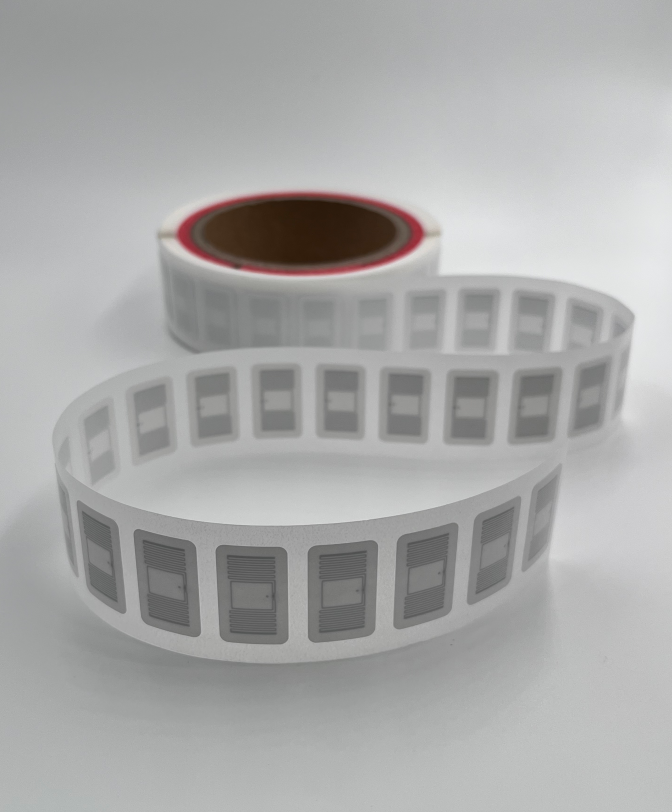
Adhesive selection for medical devices often gets locked in early based on lap shear results, but that ignores what happens when the bonded assembly enters a sterilization cycle. Steam autoclaving, for example, drives moisture into hygroscopic substrates like polycarbonate or nylon while exposing the bond line to repeated thermal expansion and contraction. A rigid adhesive that performed well at room temperature can transmit enough stress to craze the substrate or peel away from a low-energy surface after only a few cycles. Matching the adhesive modulus and cure profile to the substrate's dimensional stability under moist heat is often more important than the initial bond strength.
Radiation methods such as gamma and electron beam add another layer of risk. Some acrylic and polyurethane adhesives tolerate moderate doses without meaningful loss of toughness, while others crosslink further and become brittle, or discolor in ways that create cosmetic rejects. Metals rarely present problems here, but plastics like PTFE, PEEK, and certain polysulfones respond differently depending on filler content and molecular weight. Ethylene oxide is gentler on many heat-sensitive substrates, yet porous materials and some elastomers can retain gas if the adhesive or substrate does not allow sufficient outgassing. Low-temperature hydrogen peroxide plasma demands particular attention to surface chemistry, since certain plasticizers, silicones, or amine-containing compounds can interfere with sterilization efficacy or leave residues.
The only reliable way to match a substrate and adhesive to a sterilization cycle is to test bonded coupons through the full process, not just a single exposure. Run the intended number of cycles and measure lap shear, peel, discoloration, and weight change after each interval. A combination that survives one cycle may fail after ten because oxidative damage or moisture uptake accumulates at the interface. Prototype testing also reveals whether surface preparation or a primer is necessary to stabilize the bond. Treating sterilization compatibility as a design constraint from the start prevents the costly situation of qualifying a device only to have the bond degrade after repeated hospital processing.
Balancing Data Density With Reliable Bedside Reads
Clinical teams often find themselves pulled between two competing demands: screens packed with enough detail to support nuanced decisions, and the need for a quick, confident read at the patient’s side. Too much information can bury a subtle trend, while too little can leave a nurse or physician working from an incomplete picture. The challenge lies in arranging data so that the most actionable signals rise to the surface without stripping away the context that gives them meaning.
A practical approach is to pair high-density trend views with focused bedside summaries. Instead of forcing every parameter into a single visual layer, monitors can emphasize the values that matter most during a given care moment, while keeping secondary data accessible behind a tap or scroll. Thoughtful use of color, grouping, and consistent placement helps readers build a mental rhythm, so they spend less energy searching and more energy interpreting.
Reliability also depends on presentation choices that respect how people actually read in fast-moving environments. A bedside display should remain legible from a short distance, preserve hierarchy under different lighting conditions, and avoid visual clutter that can turn a routine check into a source of friction. When density is balanced with disciplined design, the result is not simply more data, but clearer judgment when it matters.
Stress Testing Every Batch Before It Reaches a Patient
Every finished batch goes through a deliberate sequence of stress conditions before it is cleared for clinical use. Temperature shifts, vibration, light exposure, and pressure changes are applied in controlled steps to expose weaknesses that routine checks tend to miss. The aim is not to confirm that the product survives ideal storage, but to find the earliest point where its performance drifts outside acceptable limits.
Each run is tied to a specific lot number and recorded in real time. If a batch fails at any stage, the entire lot is quarantined and investigated rather than pushed forward. That decision point is intentionally conservative: a delayed shipment costs less than a patient receiving material that behaves unpredictably.
Over time, the accumulated stress data also shapes supplier and formulation choices. Patterns that appear across batches often reveal packaging vulnerabilities or handling risks long before they become field complaints. This turns batch testing from a final checkpoint into a feedback loop that keeps tightening the margin between what a product can endure and what it must guarantee at the bedside.
Embedding Traceability Into the Tag's Physical Identity
Most traceability systems still treat the tag as a thin digital wrapper around a database record. The physical object carries a code, and that code points somewhere else. But when traceability is embedded into the tag's physical identity, the material itself starts carrying the story. A label becomes a layered artifact: its substrate, surface texture, adhesive pattern, and even the way it degrades under certain light can encode information that no copied barcode can fully reproduce.
This approach changes what counterfeiting means. Instead of simply cloning a printed number, an attacker would need to replicate the exact physical behavior of the tag under inspection, including micro-imperfections introduced during manufacturing. Those imperfections are not defects to be eliminated; they become the fingerprint. By fusing digital identity with physical variation, the tag stops being a passive pointer and becomes the evidence itself.
The practical effect is a quieter kind of trust. A supply chain partner doesn't just verify that a code matches a database entry. They confirm that the code lives on a surface whose physical character matches the one recorded at the point of origin. Identity becomes inseparable from matter, and traceability becomes something you can touch.
Controlling Variation When Each Serial Number Carries Clinical Risk
When each serial number carries clinical risk, variation is not something you can simply average out. A single lot might contain thousands of units, yet the unit that fails or triggers an adverse event is often the one that deviated from the norm in a subtle way. Traditional batch-level acceptance sampling assumes within-lot homogeneity, but this assumption breaks down when individual serialization links each unit to its own manufacturing history, raw material trace, and environmental exposure. The challenge shifts from controlling a process average to controlling the tails of a distribution, where the cost of a single outlier is measured in patient harm rather than scrap rate.
Practical control begins with mapping which process inputs create serial-level risk. For example, a filling line with multiple heads may show acceptable aggregate weight variation, but one head drifting slightly over several shifts can produce thousands of high-risk units before a batch check catches it. By pairing serial numbers with time-stamped sensor data—fill volume, seal pressure, torque, vision inspection results—you can build a per-unit risk profile. The goal is not to inspect every possible defect, but to identify which serial numbers carry a measurably higher probability of failure, and then quarantine or rework those units before they reach the patient. This turns serialization from a traceability burden into a real-time control signal.
The hardest part is deciding what level of variation actually matters clinically. A serial number that is three standard deviations from the mean on a dimensional check may be perfectly safe, while another that is one standard deviation off on a sterility parameter could be catastrophic. This requires risk-based specification limits that are tied to clinical endpoints, not just engineering convenience. Teams that do this well often maintain a living risk register linked to serial-level data, allowing them to adjust inspection rules as new failure modes emerge. In that sense, controlling variation when each serial number carries clinical risk is less about tightening tolerances and more about knowing which tolerances, for which units, actually protect the patient.
FAQ
Medical-grade polypropylene and silicone elastomers tend to survive steam autoclave cycles without cracking or yellowing. Some facilities also use PEEK for instruments that face harsh chemical disinfection, but it costs more and is harder to mold.
Curved metal surfaces expand and contract during thermal cleaning, so rigid adhesives peel quickly. A low-modulus acrylic foam tape with a conformable carrier works better, and rounding the tag edges reduces edge lift. For trays that go through washer-disinfectors, an overmolded tag is often safer than an adhesive tag.
Read range reliability in a liquid-rich environment matters more than raw memory size. Chips with high sensitivity and robust anti-collision help when many tagged items sit close together in a storage cabinet. Memory matters only if the hospital wants to store maintenance or inspection history directly on the tag.
Keep both, but do not rely on the printed layer for long life. Laser marking or pad printing onto an overmolded surface survives cleaning better than labels. Human-readable serial numbers are useful when staff need a quick visual check, while the RFID stores the full device or tray record.
Beyond checking read function, test a sample batch through the actual sterilization method the customer uses, including multiple autoclave or hydrogen peroxide plasma cycles. Also check dimensional stability, print adhesion, and read distance after the tags have fully cooled and dried, because performance can drop when the substrate is still warm.
Avoid sharp corners and thick profiles. A low, rounded profile with fully encapsulated edges is less likely to catch on wrap or tray liners. If the tag must sit on a handle, place it in a recessed area or use a tapered edge design so it does not interfere with grips or locking mechanisms.
The tag materials should be biocompatible for the intended contact level, and the finished tag must not introduce substances that could transfer to instruments. Many hospitals expect documentation for ISO 13485 or similar quality systems, plus evidence that the tag survives their cleaning and disinfection protocols.
Overmolding is worth it for instruments or trays exposed to repeated high-temperature sterilization, aggressive chemicals, or rough handling. A sticker can be acceptable for low-contact assets with shorter life cycles, but once a tag detaches or degrades it creates both a tracking failure and a possible foreign object risk.
Conclusion
Hygiene requirements in clinical settings force RFID tag manufacturers to rethink materials long before electronics are considered. Enclosed tags that survive repeated wiping, chemical disinfectants, and autoclave or hydrogen peroxide sterilization need substrates and adhesives selected as a pair, since a chemically resistant face stock can fail if the adhesive breaks down and lifts at the edge. Factories producing durable medical tags therefore treat adhesion and encapsulation not as finishing steps but as core design constraints, running small pilot batches through the same sterilization cycles a hospital would use. Every production lot is then pulled at random and subjected to thermal shock, fluid immersion, flexing, and read-range checks because a tag that survives the lab but fails on a surgical tray is not acceptable.
Beyond survival, the tag still has to perform at bedside without forcing nurses into awkward positioning. This requires deliberate antenna tuning and memory partitioning so high-density asset data does not degrade the short-range read reliability needed in a busy ward. Factories also embed traceability into the tag's physical identity by laser-marking a secondary identifier on the housing and logging the IC's unique factory-programmed number during assembly, which gives hospitals two independent paths to verify a device. Because each serial number may later be tied to a patient record or sterilization event, variation control becomes a patient-safety issue: duplicate identifiers, skipped ranges, or mixed batches are treated as critical defects rather than administrative annoyances.
Contact Us
Contact Person: Esme Mo
Email: [email protected]
Tel/WhatsApp: 0086 191 2931 7837
Website: https://www.osrfidglobal.com/