
Custom Swiss-Type Precision Parts Machining: Inside Our Advanced Factory
2026-05-23
Swiss-type machining is more than a process—it's a pursuit of microscopic perfection. Inside our advanced facility, WINNRUI CNC transforms raw metal into components that defy the limits of precision. What makes our factory different? It's the quiet hum of Swiss lathes running non-stop, the gleam of freshly cut parts under inspection lights, and a team obsessed with getting every micron right. Step behind the scenes and discover the craftsmanship that fuels medical devices, aerospace marvels, and beyond.
Where Micron-Level Precision Meets Raw Engineering Passion
In the world of advanced manufacturing, there's a threshold where technology stops being an abstraction and becomes a physical act of will. It's the micron—a unit so small that a single human hair seems colossal. Here, precision isn't just a spec on a datasheet; it's a ritual performed by machines and minds aligned in obsessive synchrony. Every measurement, every correction, every imperceptible adjustment is a dialogue between steel and intent. This is the realm where raw engineering passion doesn't just complement exactness—it fuels it, driving craftsmen and innovators to push beyond what's comfortable and into what's necessary.
But passion, on its own, is chaotic. It yearns, it burns, it disrupts. Left unchecked, it’s a sledgehammer in a world that demands the finest scalpel. The magic happens when that unrefined drive is channeled through the lens of micron-level awareness. Imagine a machinist who can feel the subtle chatter of a cutting tool before any sensor even blinks, or an engineer who redesigns a component not because the math failed, but because their intuition sensed a better harmony. This fusion of instinct and exactitude gives birth to creations that feel almost organic in their perfection—parts that fit with a satisfying certainty, surfaces that gleam with purpose, and assemblies that perform silently, confidently.
We don't just chase tolerance ranges here; we chase the electrifying moment when a digital blueprint becomes a flawless physical reality. It’s a deeply human endeavor masked in the cold language of micrometers and surface finish charts. Each project is a battle against entropy, where the victory isn't measured in microns alone, but in the shared glance between team members who know they've created something unreasonably precise. This is engineering stripped of its corporate veneer—sweaty, brilliant, and relentlessly committed. Where micron-level precision meets raw engineering passion, you don't just build parts. You sculpt the future, one impossibly tiny step at a time.
Decoding the Swiss-Type Lathe Advantage for Custom Parts
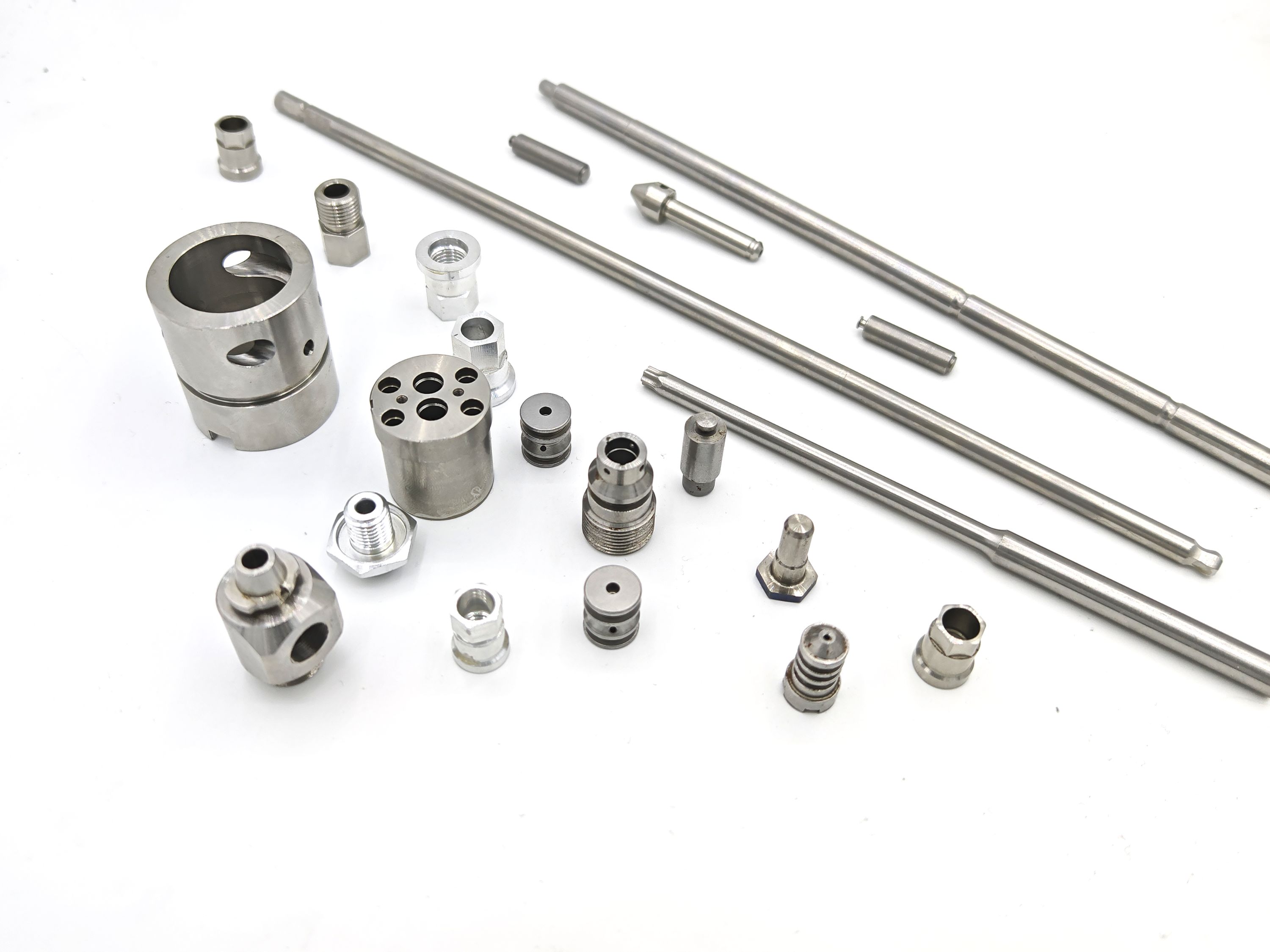
Most machine shops treat Swiss-type lathes like Swiss Army knives—handy but strictly for tiny, complex widgets. That misses the point entirely. The real advantage isn't just the sliding headstock; it's how the guide bushing virtually eliminates workpiece deflection, letting you hold tolerances on long, slender parts that would chatter to death on a conventional lathe. When you're prototyping custom shafts with length-to-diameter ratios that make engineers wince, that rigidity isn't a feature—it's the only way to get a part that doesn't need a secondary straightening op.
Beyond the geometry trick, Swiss machines collapse setups in ways that rewrite the cost equation for one-offs and small batches. A single cycle can turn, mill, drill, broach, and even hob splines while the bar stock is still firmly gripped—no chuck swaps, no repositioning errors. For custom work where every minute of operator attention eats into margin, that autonomy turns a niche machine into a profit center. I've seen shops cut part costs by 40% simply by letting the Swiss do in one handling what used to require three separate machines and a lot of pacing around.
From Concept Sketch to Flawless Component: Our Process Unveiled
Every creation starts with a rough idea scratched onto paper or a digital canvas, capturing the essence of what’s to come. We don’t just take that sketch at face value—we dissect it, challenge its assumptions, and refine its purpose until the vision is crystal clear. This early stage is all about curiosity and collaboration, where raw concepts are molded into a blueprint with genuine potential.
From there, we move into a rhythm of iterative prototyping, testing materials and mechanics that often reveal unexpected insights. Our team thrives on these discoveries, turning obstacles into design features that elevate the final product. Each version is stress-tested and scrutinized, not just for durability, but for that intangible sense of rightness that separates good from exceptional.
The final leap from prototype to flawless component happens when every detail aligns—form, function, and feel. We polish relentlessly, but never lose sight of the original spark that started it all. The result is something you can hold, use, and trust, born from a process where craftsmanship meets creativity without compromise.
Inside the Cleanroom: Contamination-Free Machining Secrets
Inside a precision cleanroom, every detail is engineered to eliminate contamination before it becomes a problem. The air itself is constantly scrubbed, cycling through HEPA and ULPA filters that trap particles down to a fraction of a micron. Personnel don full bunny suits, gloves, and face masks not as an afterthought but as a fundamental part of the process—human skin flakes and breath moisture are among the most persistent threats to sensitive machining. Tools and materials enter through airlocks and pass-through chambers, where they’re wiped down with isopropyl alcohol and inspected under magnification. It’s a world where a single speck of dust can scrap a component, so the environment is treated as a critical manufacturing layer.
Machine tools inside these spaces are often modified to shed as few particles as possible. Coolants are chosen for their purity and low outgassing, and some operations replace liquid coolants entirely with dry machining or clean compressed air. Bearings and guideways are sealed or flushed continuously to keep abrasion debris from escaping. Even the cleaning protocol is a carefully choreographed sequence: wipes are folded to present fresh surfaces with each stroke, and cleaning agents are applied in controlled amounts to prevent flooding. These practices aren’t just about meeting an ISO class rating—they’re about achieving a rhythm where contamination control becomes second nature.
What often surprises newcomers is the level of monitoring that runs in the background. Particle counters sample the air at multiple points and feed data to dashboards that track trends over time. Surface cleanliness is verified with swab tests and occasionally with real-time analyzers that can detect organic residues invisible to the naked eye. When issues arise, the investigation traces back through logbooks, material certifications, and maintenance records with a rigor that resembles forensic science. In the most demanding shops, every shift starts with a brief but intense inspection of seals, filtration units, and electrostatic discharge grounding points—because the best secret to contamination-free machining is that there is no single secret, only a relentless, ingrained habit of vigilance.
Material Mastery: Working with Exotics Without Compromise
There’s a quiet arrogance in believing that exotic materials bend to standard practice. Stuff like carbon composites, aerogels, or high-entropy alloys don’t care about your deadline. They come with a condition: understand me, or watch me fail. The trick isn’t finding a workaround—it’s rethinking the entire chain of custody. From the moment a raw billet of Inconel hits the shop floor, you’re not just machining; you’re negotiating thermal expansion coefficients, work-hardening rates, and the subtle anger of a material that won’t forgive a single bad pass. Get it right, and the payoff is a component that laughs off temperatures that would turn steel into spaghetti.
But raw knowledge won’t cut it. You’ve got to feel how a tungsten-heavy alloy shifts under load, how the grain structure of a forged titanium block dictates tool engagement. That feel doesn’t come from datasheets—it’s bought with scrap. The best fabrication teams keep a logbook of failures because each shattered cutting insert tells you exactly where the material begins to push back. And pushing back is what exotics do best. They’re not just stronger or lighter; they actively refuse the shortcuts that mass production ingrains in us. Skip the cool-down cycle on a ceramic-matrix composite? That’s not a cosmetic flaw—it’s a micro-crack network that’ll propagate under cyclic stress until the part disassembles itself mid-flight.
Compromise, then, is the real enemy. You can’t tune out the expensive lessons and expect a different result. The veteran fabricators I’ve learned from don’t talk about “handling” exotics—they talk about partnering with them. It’s a relationship built on humility and the constant, low-grade anxiety that keeps you checking ultrasonic scans at 2 a.m. That anxiety is the price of admission. Pay it upfront, and these materials will deliver properties that border on unfair. But there’s no shortcut, no clever jig that replaces the hours spent learning how a sintered metallic glass wants to be ground. The material sets the rules. You either adapt, or you produce very expensive confetti.
Beyond Tolerances: How We Validate Every Custom Part
When a custom part arrives, it’s not just a set of numbers on a drawing that matters. Tolerances tell you if a dimension lands within an acceptable range, but they don’t reveal how the surface interacts with a mating component, how the material behaves under sustained load, or whether a subtle edge radius creates a stress riser that’ll cause problems later. That’s why our validation process starts where traditional inspection ends: we physically assemble the part into its intended environment, measure performance characteristics that no CMM can capture, and often test to failure just to understand the real margin of safety. It’s the difference between a part that technically passes and one that actually works for years.
We’ve built a verification workflow that mimics the part’s entire lifecycle in condensed form. First comes a thorough visual and tactile assessment—our machinists run their fingernails along critical edges, look at grain structure under magnification, and compare the part against legacy components that have logged thousands of service hours. Then we move into functional rigs: custom-built fixtures that replicate the exact loading, vibration, and thermal cycling the part will see in the field. One recent titanium bracket, for instance, was subjected to 800,000 cycles of asymmetric loading while soaked in a saline mist to validate both fatigue life and corrosion resistance simultaneously—a combination you won’t find in any standard spec.
The real value emerges when we feed lessons from testing back into design and manufacturing. Every anomaly, whether a micro-crack detected by dye penetrant after thermal shock or an unexpected harmonic resonance at a certain RPM, gets documented and cross-referenced with the original machining strategy. This closed loop means the next iteration of the part isn’t just a copy of the last—it’s an evolved version that sheds latent weaknesses. Over time, this approach has created a library of tribal knowledge that lets us validate new parts faster and with deeper confidence, because we’re not just checking boxes; we’re building a physical understanding of what it takes to survive in the real world.
FAQ
We handle everything from micro-components for medical devices to intricate automotive connectors, with diameters as small as 0.3mm up to 32mm. Complex geometries with tight tolerances are our specialty.
Our climate-controlled facility uses inline probing and laser measurement systems that check critical dimensions automatically during production. We also employ statistical process control to catch variations before they become issues.
Stainless steel, titanium, brass, and engineering plastics like PEEK are daily fare. We've developed tooling strategies for each, so even challenging alloys machine efficiently without sacrificing surface finish.
Absolutely. We've optimized our setup for quick changeovers, so we can produce five prototype parts or five thousand production units with the same attention to detail and consistency.
Beyond our advanced equipment, it's our in-house secondary operations—like thread rolling, knurling, and sub-micron deburring—that let us deliver truly turned-key parts without sending anything out.
Medical, aerospace, and high-end electronics are our core markets. We're often trusted with components where failure isn't an option, such as surgical instruments and satellite connectors.
Yes, we provide passivation, anodizing, and laser marking in-house. We also have a dedicated quality lab for full dimensional inspections and material certifications if needed.
Conclusion
Step inside our advanced factory for custom Swiss-type precision parts machining, and you’ll feel it immediately—a place where micron-level accuracy isn’t just a target, it’s an obsession, fueled by a genuine, hands-on engineering passion. Swiss-type lathes sit at the heart of our capability, turning slender, complex geometries that conventional machines would struggle to hold. The magic lies in their guide bushing and sliding headstock design, which keeps the workpiece rigidly supported mere millimeters from the cutting edge, virtually eliminating deflection. This makes them unmatched for crafting long, intricate shafts, miniature medical components, or watch-grade micro-parts where a few microns make or break functionality. Every batch starts with raw creativity—a concept sketch, a napkin drawing—then our team rapidly prototypes and refines, using real-time tool monitoring and decades of machining instinct to push the limits of what steel, titanium, or even Inconel can become.
Behind the humming machines, you’ll glimpse our cleanroom—a positively pressurized, ISO Class 7 sanctuary where contamination is the enemy. No fingerprints, no airborne specks dare compromise sensitive fluid paths or optical surfaces; it’s the secret behind our clients’ most critical assemblies. Material mastery here means going beyond the usual alloys: we machine exotics like Hastelloy, zirconium, and PEEK with the same confidence as aluminum, dialing in speeds, feeds, and tool coatings through years of trial and triumph. But we don’t stop at hitting the print. Every custom part enters a metrology gauntlet—laser micrometers, CMMs, and optical comparators validate dimensions, surface finish, and roundness, often to tolerances tighter than a red blood cell. It’s a relentless pursuit, not just to meet spec, but to deliver components that embody the craft, precision, and pride that define our entire factory floor.
Contact Us
Contact Person: Tim
Email: [email protected]
Tel/WhatsApp: +86 15522553731
Website: https://www.winnrui-cnc.com/