

China Crystal Label Factory for Premium Custom Crystal Label Solutions
2026-11-16
When your product deserves a label that catches the light and holds attention, you can't afford to settle for ordinary. China has become the go-to source for premium custom crystal labels, and Xinsen is a factory that takes this craft seriously. What really goes into a crystal label that looks flawless and lasts for years? In this post, we'll pull back the curtain on our materials, production techniques, and quality standards—so you can decide with confidence.
Where Every Crystal Label Gets Its Edge
The edge of a crystal label is never an afterthought. Each blank is first inspected under magnification to map micro-fractures and grain direction, then routed through a sequence of diamond-impregnated laps that remove material in passes no thicker than a few microns. The final bevel is not a single flat plane but a compound curve that catches light from multiple angles at once, giving the label a quiet shimmer even before any printing is applied.
What separates one crystal label from another often comes down to how that edge interacts with the surface it sits on. A slightly steeper shoulder keeps the label from snagging on fabric or packaging film, while a softer radius lets it lie flatter against curved containers. Our process tests three different edge profiles for every new substrate, rejecting any that create visible gaps or allow adhesive to creep up the side. The result is a label that looks deliberate, not die-cut in a hurry.
That same edge also protects the printed layer. By sealing the perimeter with a fused polymer ring instead of leaving raw acrylic exposed, moisture and cleaning agents lose their usual entry points. We have seen labels survive repeated wipe-downs and temperature swings that would lift a standard sticker within weeks. This is the edge that matters: not just how it looks at first glance, but how it holds up long after the unboxing.
Custom Shapes That Break the Rectangle Mold
Most products slide into the world inside rectangles because it is easy—easy to cut, stack, ship, and store. But easy rarely wins attention. When a brand chooses a hexagonal soap sleeve, a curved carton for a wine bottle, or a triangular mailer, it refuses the default. That refusal creates an immediate visual pause, a moment of physical curiosity that a flat-sided box almost never earns. The shape itself becomes the message, signaling that someone cared enough to rethink the container, not just the label.
Breaking the rectangle also changes how an object is handled and remembered. A rounded edge or a silhouette that mirrors the product inside makes unboxing feel deliberate. People hold these packages differently, turn them over, display them instead of discarding them. The form asks for a second glance, and that second glance often carries more weight than a louder graphic or a brighter color. It is not merely decoration; it is a tactile argument that the brand treats shape as a design choice rather than a given.
This approach is not always practical. Custom shapes can increase material waste, complicate transport, and demand more precise engineering. Yet when the shape aligns with the product's story, the trade-off pays off. A rectangle is a default, not a rule. Brands that see it that way—and are willing to break it with intent—often earn the kind of notice that straight edges struggle to buy.
Why Small Batches Deserve Big-Factory Precision
A limited production run often gets treated as a shortcut—fewer pieces, less scrutiny, looser expectations. But small batches actually make precision more critical, not less. When you’re only making a handful of parts, a single deviation isn’t buried in a mountain of output; it defines the entire order. That raises the bar for every measurement, every setup, every final check.
Precision has nothing to do with factory square footage and everything to do with process discipline. A five-unit run can achieve the same repeatability as a five-thousand-unit run when it relies on calibrated tools, documented tolerances, and well-maintained fixtures. In fact, smaller batches allow for closer inspection and quicker corrections, because you can pause and verify without disrupting a massive line. That’s how boutique operations often deliver more consistent results than sprawling high-volume plants.
The Adhesive and Resin Choices That Define Durability
The real test of a bonded joint isn't how it holds on day one, but how it behaves after years of thermal swings, moisture intrusion, and repeated load cycles. Epoxy systems still dominate when structural integrity can't be compromised, largely because their cross-link density can be tuned by adjusting the hardener ratio and cure schedule. Yet not all epoxies are equal—cycloaliphatic formulations outperform standard bisphenol-A types in UV exposure and high-temperature environments, while rubber-modified epoxies absorb micro-cracks that would otherwise propagate through a more brittle resin matrix. Choosing the wrong subtype often leads to adhesion failure that looks like a material defect but is actually a chemistry mismatch.
Polyurethane adhesives bring a different kind of durability to the table: flexibility without sacrificing strength. Where epoxies resist deformation, polyurethanes move with the substrate, making them ideal for bonding dissimilar materials with different coefficients of thermal expansion. The trade-off is their sensitivity to moisture during curing—excess humidity causes foaming, while insufficient humidity stalls the reaction entirely. Formulating with blocked isocyanates or moisture-scavenging fillers can mitigate this, but it demands a level of process control that many manufacturers overlook. In exterior applications, aliphatic polyurethanes are essential because aromatic versions yellow and embrittle under sunlight.
Resin selection extends beyond the base polymer to the additives that quietly dictate long-term performance. Toughening agents like core-shell rubber particles or thermoplastic interlayers can double the fracture toughness of an epoxy without compromising its glass transition temperature. Coupling agents—often silanes—create a molecular bridge between inorganic fillers and the organic resin, preventing hydrolytic degradation at the interface. Even the choice of cure catalyst matters: tertiary amines accelerate epoxy reactions but can promote corrosion on metal substrates if not neutralized. These details rarely appear on a product datasheet, yet they separate adhesives that survive a decade outdoors from those that fail after two seasons.
From Sample to Shipment Without the Usual Delays
Getting a new product from sample approval to final shipment often involves bottlenecks that quietly eat away weeks. One common culprit is the back-and-forth over minor discrepancies that could have been caught earlier. Instead of letting a tiny stitch difference or a slightly off shade trigger another round of revisions, we treat every sample as a learning snapshot. We document what worked, flag what didn’t, and lock in those details before bulk fabric is even cut. That way, the production run doesn’t start with unresolved questions—it starts with a shared understanding that has already been stress-tested.
The other major source of delay is waiting for materials to arrive after the line is supposedly ready. We flip that sequence: production planning begins while the sample is still in transit. Our team checks yarn availability, dye lot consistency, and trim inventory in parallel with the approval process. If a specific zipper or lining is running low, we know before it becomes a panic. By the time the final sample is signed off, the raw materials are already staged and the cutting schedule is set. This small shift in timing removes the idle days that tend to accumulate between “approved” and “first piece out.”
Finally, we measure everything that moves—not to build reports, but to see where hours actually disappear. When a shipment misses its window, it’s rarely one big failure. It’s the sum of ten small ones: a label that had to be reprinted, a packing list that changed at the last minute, a carton that didn’t fit the pallet. We track these micro-delays on a running board and tackle the top three every month. Over time, the usual frictions simply stop happening. The result is a pipeline where sample approval and shipment are not two distant events, but two points on a single, uninterrupted line.
What Direct Factory Access Means for Your Label Budget
When you buy labels through a broker or reseller, every quote includes a markup that covers their overhead and commission. Going straight to the factory strips that layer away. The price you see is built from raw materials, press time, and finishing—nothing else padded on top. For smaller runs, that can mean the difference between a risky stretch and a comfortable fit in your monthly packaging spend.
Direct access also changes how you plan. Instead of waiting on a middleman to relay questions about die sizes, adhesive options, or material availability, you talk with the people who actually run the machines. That shortens approval loops and reduces costly misprints. It also gives you flexibility to adjust order quantities without triggering a new round of distributor fees, so your budget stays responsive to real demand rather than locked into someone else's schedule.
There's a common assumption that factory-direct means bare-bones service, but it's often the opposite. A factory invested in repeat business will help you choose a label construction that avoids overpaying for unnecessary durability, or suggest a liner change that lowers freight weight. Those conversations keep your per-label cost down in ways a catalog or a third-party quote sheet rarely shows.
FAQ
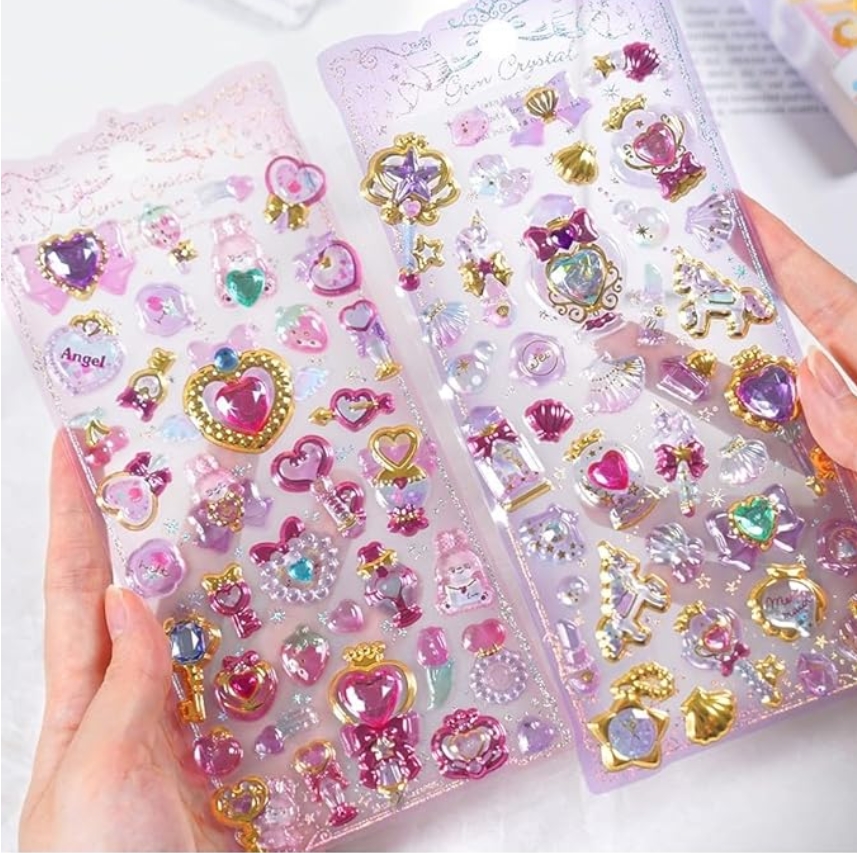
We mainly handle domed epoxy crystal labels, UV-printed crystal stickers, and 3D bubble labels. Depending on the design, we can also combine metallic foil, holographic effects, or glow-in-the-dark layers. The base is usually polyurethane or epoxy resin, and we adjust thickness from about 0.3mm to 2mm to match the product surface.
You can send us a sketch or even a phone photo of something similar. Our in-house designer will turn it into a vector file and show you a digital mockup within two working days. We allow three rounds of revisions at no extra cost before you approve the sample.
For standard sizes under 50mm, the MOQ is 500 pieces. For larger or unusually shaped labels, it's usually 1,000 pieces. If you need just a few dozen for a prototype, we can run a sample batch with a setup fee that is later deducted from your bulk order.
Yes, if we use the UV-resistant polyurethane dome. It holds up against sunlight, rain, and temperature swings from -30°C to 80°C. We've produced labels for motorcycle helmets, fishing rods, and power tools that still look new after two years of heavy use. However, for long-term submersion in saltwater, we recommend an extra sealing layer.
We use Pantone matching and offer gloss, matte, and soft-touch finishes. A physical color proof is sent before mass production, and the tolerance is within ±5% of the target. If you need a metallic or gradient effect, we can also print with hot stamping or digital gradient on the base layer.
After sample approval, production takes 10 to 14 days for up to 10,000 pieces. Larger orders may take 18 to 21 days. Shipping is separate; we can arrange express, air, or sea freight, and we will give you a tracking number as soon as it leaves the factory.
We offer 3M permanent adhesive, removable adhesive, and a high-tack version for textured or low-energy surfaces like powder-coated metal. The liner can be split or tabbed for easy peeling. If you're not sure which to choose, we can send a small adhesion test kit for your specific material.
The dome is poured, not laminated, so the surface has a deep, glass-like curve that catches light. We also cure the epoxy under controlled humidity to prevent yellowing and bubbles. The result is a label that feels like a solid badge rather than a flat sticker, and we back it with a 12-month warranty against delamination and fading.
Conclusion
A crystal label only works when its edges feel as deliberate as its surface. This factory treats that step as a craft, not an afterthought—beveled, rounded, or sharply faceted finishes are matched to the label’s final use. Beyond the standard rectangle, the production line handles contours that many suppliers refuse to quote: teardrop logos, hexagonal badges, and asymmetric cutouts are cut and polished with the same registration accuracy usually reserved for large runs. Even a few hundred pieces get full digital die-cutting and layered resin pours, so a boutique batch gets the same crispness as a mass order.
Durability comes down to the adhesive and resin system, and the choices here are not one-size-fits-all. Whether the label needs to survive freezer condensation, high-friction handling, or outdoor UV exposure, the team selects from tested combinations rather than relying on a single default glue. Samples move from approved artwork to physical mockups without the typical multi-week lag because prototyping and production share the same floor. Ordering directly removes the middle markup, which means the budget can shift toward thicker doming, better adhesive, or more complex shape work—without inflating the per-unit cost. That kind of access turns a commodity label into a small but serious product detail.
Contact Us
Contact Person: Yara
Email: [email protected]
Tel/WhatsApp: +86 13505426090
Website: https://www.qdxspack.com/