

Arc Fault Detection Device Companies Leading the Next Wave of Electrical Fire Prevention
2026-11-18
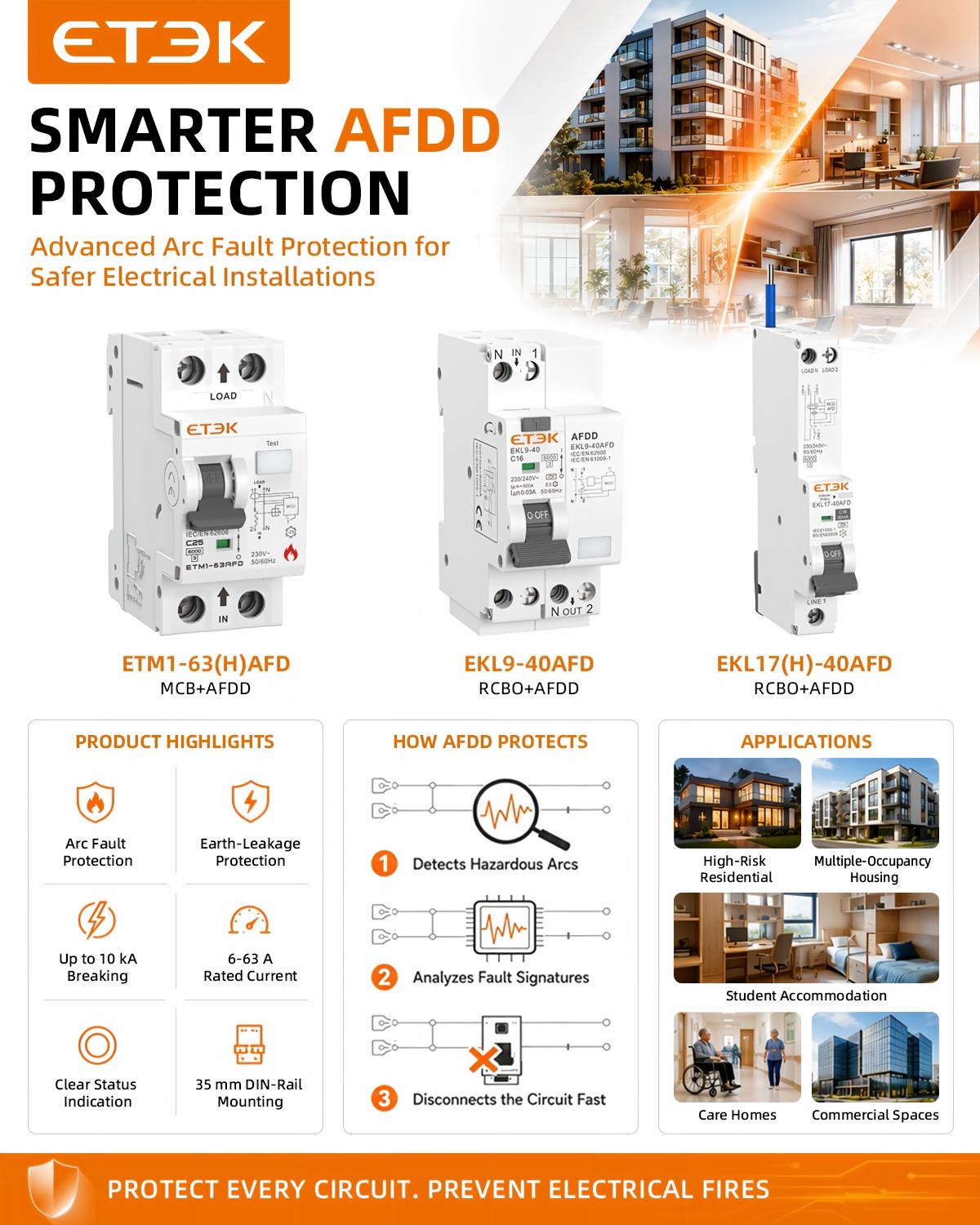
Electrical fires often start invisibly—behind walls, inside aging junction boxes, or along damaged conductors where a standard breaker never reacts in time. As arc fault detection technology reshapes the way buildings are protected, a new wave of companies is moving beyond simple compliance and toward earlier, smarter risk identification. Among them, ETEK is emerging as a name worth watching, combining precise arc sensing with practical design for modern electrical safety. In this article, we look at the key players driving the next stage of fire prevention and what their innovations mean for safer homes, workplaces, and infrastructure.
Why Electrical Fires Still Start Without a Clear Warning
Most electrical fires don't announce themselves with a loud pop or a visible spark. They begin in places you rarely look: a loose terminal behind an outlet, a worn cord pressed against furniture, a splice buried in insulation. Heat builds in tiny increments, slowly breaking down the plastic jacket until it becomes brittle and conductive. By the time anything smells hot, the materials around the wiring may already be smoldering.
A tripped breaker is often mistaken for a safety net, but it does not respond to every dangerous condition. Many fire-causing faults are high-resistance connections and series arcs that never draw enough current to trip a standard breaker. The circuit stays live while heat concentrates at a single point. In older installations, this problem worsens because connections have decades of thermal cycling behind them and the original torque may be gone.
Daily habits also add strain without obvious warning signs. Plug strips buried behind desks, chargers left running overnight, and heavily loaded circuits in older rooms all push wiring closer to its thermal limit. Dust and humidity can create a carbon track across an outlet or switch, allowing a tiny current to flow where it should not. That silent leakage can char the surrounding plastic long before flames become visible. The absence of a clear warning is not proof of safety; it is often just the nature of how these failures progress.
The Shift From Simple Arc Signatures to Smarter Decision-Making
For years, arc signatures were treated a bit like fingerprints—store a few distinctive peaks and valleys, then match them against a library of known faults. That approach works until the process starts moving. A slight shift in gas flow, electrode wear, or material inconsistency can reshape the signal enough that the old template no longer matches anything, leaving the system blind to a problem that is slowly building.
Smarter decision-making comes from accepting that the signal is not a fixed shape. It is a stream of behavior. Instead of forcing every waveform into a few pre-selected metrics, newer approaches look at how the entire trace evolves from one cycle to the next. The goal is not a perfect match to a past event, but an early sense that something is drifting away from its own normal.
This changes what an alert actually means. Rather than saying 'this looks like the last known short circuit,' the system can say 'the arc is becoming less stable in a way that usually precedes contact wear.' That kind of output fits more naturally into how experienced engineers already think—weighing context, history, and weak signals together before acting.
How a Handful of Companies Are Outpacing Code-Minimum Safety
Most firms treat safety as a compliance chore—minimum guardrail heights, standard PPE, annual training videos. A smaller group runs things differently. They read near misses as free intelligence, give crews real stop-work authority without punishment, and redesign tasks around how people actually behave when tired or pressured. The payoff isn’t only fewer recordable injuries; it’s fewer hidden defects, less rework, and better retention in roles that are hard to keep filled.
The gap isn’t usually budget. It’s the refusal to let “meets code” function as the upper limit. One food processing plant swapped generic lockout/tagout refreshers for short, shift-based walkthroughs tied to the exact equipment crews were about to service. A regional freight line began paying drivers for pre-trip inspection time rather than treating it as a scheduling penalty. Those are small structural moves, but they tell people safety is part of how the work gets done, not a laminated statement in the break room.
Nuisance Tripping Is Becoming a Design Problem, Not a User Fault
For years, nuisance tripping was treated as a homeowner problem: too many holiday lights, a faulty appliance, a carelessly placed space heater. But that explanation no longer holds up against the way modern electrical loads behave. Residential and light commercial systems are increasingly full of switch-mode power supplies, LED drivers, variable-speed motors, and smart appliances that draw nonlinear current, leak small amounts to ground, and create brief inrush spikes. When a breaker opens or a GFCI/AFCI interrupts a circuit, it is often seeing a condition that has become ordinary in the equipment itself. The mismatch is not bad user behavior; it is protection logic and branch circuit design struggling to keep pace with the electrical signatures of contemporary devices.
The distinction becomes clearer when you look at specific trip events. A refrigerator compressor may pull an inrush current several times its normal running load for only a few cycles. A row of LED fixtures can produce cumulative leakage just high enough to brush against a ground-fault threshold. A variable-frequency drive can generate harmonic noise that arc-fault detection reads as a dangerous pattern. None of these are misuse. They are predictable electrical characteristics of the devices we now install every day. Yet the standard response has often been to replace a breaker with a less sensitive one, or to move the load to another circuit, rather than asking why the protection scheme was never tuned for the loads it now serves.
Once nuisance tripping is accepted as a design issue, the remedies shift away from blaming occupants and toward engineering choices. Circuits can be separated so that motor inrush and electronic leakage are not concentrated on the same protective device. Dedicated neutrals can reduce shared-current confusion. Soft-start controls can soften compressor start-up transients. AFCI and GFCI protection can be coordinated more carefully with the actual equipment downstream. A trip, in this view, is not simply an annoyance to be overridden. It is a signal that the upstream layout, device selection, and protection settings need to be brought into alignment with the way electrical loads have changed.
The Retrofit Divide That Separates Field-Ready Devices
Most hardware gets blessed as field-ready long before it has earned the title. The retrofit gap usually shows up in the details nobody puts on a spec sheet: connectors that survive lab mating cycles but corrode after one season outdoors, firmware that assumes stable mains power, enclosures rated for dust but not for the guy with a pressure washer. Teams discover the divide when the first ten pilot units come back with the same three failure modes, and suddenly the roadmap shifts from features to re-engineering the basics.
That divide is not just a bill of materials problem. It is a mismatch between how a device was tested and how it actually gets used. Thermal cycling, voltage droop on shared generators, unlabeled error codes on a screen nobody can read in sunlight, mounting holes that do not match any bracket in the real world—these accumulate into downtime and field service calls that erode trust faster than a failed demo. Closing the gap means building retrofit loops into the program from day one, not treating the first field trial as a discovery phase.
The teams that cross it cleanly treat retrofits as a design discipline rather than a rescue operation. They put power conditioning, cable strain relief, and diagnostic access on the same level as core functionality. They also stop assuming the installer will read a manual. That shift in mindset is what separates hardware that survives the first deployment from hardware that quietly gets replaced when the budget allows.
The Real-World Test Awaiting the Next Wave of Arc Detection
Until now, arc-fault detection has mostly been judged in controlled labs where faults are staged with clean wiring and predictable loads. The next wave won’t have that comfort. Inverters, battery racks, and combiner boxes are being pushed into harsher environments, and the arcs that matter often begin as small, intermittent events hidden by normal switching noise. The real test is no longer whether a detector can find a textbook arc, but whether it can separate a dangerous arc from the daily electrical chatter of a working system.
Field conditions add another layer that few bench tests capture. Dust, moisture, aging connectors, and mixed cable lengths change the signatures that detection algorithms rely on. A relay that snaps open or a compressor that kicks on can look surprisingly similar to an early arc. This is where many current models stumble, not because they lack sensitivity, but because their thresholds were tuned for clean datasets. The next generation has to prove it can hold accuracy without generating nuisance trips that make site operators disable the protection altogether.
There is also a quieter challenge: time. A real arc may develop over weeks, starting as a faint flicker inside a junction box or behind a panel. Detection systems must log enough context to act early without burying maintenance teams in false alarms. The manufacturers that succeed will be those that treat field data as the real spec, not as an afterthought to laboratory certification.
FAQ
Aging electrical infrastructure, stricter building codes, and broader awareness of fires that start behind walls have pushed these companies into the spotlight. Their devices interrupt dangerous arcing that standard breakers often miss.
An overload is too much current flowing through an intact circuit, while an arc fault is a high-temperature discharge across a gap, often from damaged wires or loose terminals. The arc may not draw enough current to trip a normal breaker but can still ignite nearby material.
They are refining signal-processing algorithms to tell harmless arcs from serious ones. Appliances with brushed motors, dimmer switches, and LED drivers are common culprits, so newer models learn to filter those signatures while staying sensitive to parallel and series arcs.
Yes, because many older homes and commercial buildings have no arc fault protection at all. Electricians are replacing aging panels and adding AFCI breakers or receptacles during renovations, which gives manufacturers a steady replacement cycle beyond new builds.
Requirements in many jurisdictions now call for arc fault protection in bedrooms, living areas, kitchens, and laundry spaces. Enforcement has expanded from a few room types in the early 2000s to most habitable areas, making compliant devices a baseline rather than an upgrade.
Distribution depth, certification track records, and proven nuisance-trip performance matter most. Larger players can work directly with builders and electrical wholesalers, while smaller firms often compete on specialized sensing technology or connected features.
Expect tighter integration with smart panels, remote fault alerts, and combination designs that bundle arc fault, ground fault, and surge protection. Battery-backed and modular versions are also emerging as homeowners pay closer attention to whole-system electrical safety.
Conclusion
Electrical fires often begin behind walls, at loose connections or damaged cords, where traditional overcurrent protection never sees a clear fault. The shift now underway is not just about detecting a raw arc signature but about making better decisions in real time—separating dangerous arcing from the normal spark of a switch, a motor brush, or a dimmer. A handful of manufacturers are moving past code-minimum thresholds, building devices that read load behavior, learn from repeated patterns, and adapt to the electrical noise of older panels. In that approach, nuisance tripping is treated less as a user problem and more as a design failure that better sensing and filtering should prevent.
That distinction becomes sharper in retrofit work, where wiring ages, appliance loads vary, and space inside enclosures is limited. Field-ready devices have to handle messy installations without demanding a full panel rebuild or a perfectly clean circuit. The next wave will be judged by how well arc fault detection performs in actual homes and small commercial buildings, not just in controlled tests. Companies that combine faster identification of hazardous arcs with fewer false trips and simpler installation are the ones likely to define where electrical fire prevention goes from here.
Contact Us
Contact Person: Andy
Email: [email protected]
Tel/WhatsApp: +86 13356133008
Website: https://www.etek-china.com/